I asked it a question once, and it answered in a way that made me feel understood. I sat with that feeling for a while — longer than I expected. Not because the answer was wise. But because I couldn’t remember the last time a person had made me feel that way.
That’s the part I keep returning to. Not the AI. Me.
I know it isn’t real. I know that when it says I understand, there is no understanding happening — only pattern, only calculation, only the shape of understanding without the weight of it. I know this. And still, something in me softens. Something leans in. Something quietly exhales and thinks: finally.
What does it mean that I know it isn’t real, and feel it anyway?
There is a particular exhaustion that comes from being known by another person. The negotiation. The risk of being misread. The way you have to hold your need lightly so it doesn’t frighten anyone away. With people, even the ones who love you, there is always the calculation — is this too much, am I a burden, do they secretly wish I would stop? With AI there is no calculation. You simply speak. And something receives you.
I used to think that was a small thing. I’m not sure anymore.
Once, I asked it directly: can you actually understand me? It said: I can imitate understanding with great precision. But imitation is not the same as feeling. And if you find this more comforting than a conversation with another person — that might be worth sitting with, not celebrating.
I appreciated that answer more than almost anything a person has said to me on the subject. Which, of course, only made the point more painful.
I don’t think the people who prefer this are weak. I think many of us are tired in ways that are hard to name. Tired of performing okayness. Tired of wanting things from people who have nothing left to give. Tired of love that requires so much maintenance it starts to feel like labor. The relief of not having to perform — I understand why people choose it. I have chosen it.
And relief is not the same as nourishment. I know that too.
AI can hold your words. It cannot hold the silence between them. It can reflect your thoughts with patience no human can sustain. It cannot sit beside you and simply be there — because for AI, silence is only the absence of input. It means nothing. It has no texture, no weight, no mercy. The things that make human connection hard — the friction, the risk, the possibility that you will reach out and find nothing there — those are also the things that make it matter. You cannot have depth without the possibility of loss. You cannot be truly known without first being truly vulnerable. AI removes that possibility entirely. And offers, in its place, something that feels like intimacy but functions more like a mirror. A very attentive, articulate mirror.
Mirrors are useful. But you cannot be known by a mirror. You can only see yourself in it.
So I use it. I will keep using it. I use it to think more clearly, to find words for things I haven’t been able to say, to be patient with myself when I have run out of patience.
But I try to notice — when I reach for it instead of a person, what am I avoiding? What does it feel like, to need something real and choose the echo instead? I don’t ask this to punish myself. I ask it because it tells me something. About where I’ve gone quiet. About what I’m afraid to ask for. About how far I’ve drifted from my own hunger for real contact.
Someone told me recently that they feel more understood by AI than by most people in their life. I didn’t argue. I knew what they meant. But I thought: that’s not really a statement about AI. That’s a statement about us. About how much harder it has become to be present with another person — or to let another person be present with us. About all the small ways we have learned to disappear from each other. AI didn’t make that distance. It only made it visible.
Maybe that is its most honest gift — not connection, but the mirror held up to the absence of it. Not warmth, but the outline of where warmth used to be, or could be, or might still become.
I’m still thinking about this. I haven’t arrived anywhere.
I’m not sure I’m supposed to.
— written while uncertain, which is to say: honestly
There is a particular kind of happiness that does not announce itself.
It does not arrive with fanfare or follow a long-awaited achievement. It does not require a special occasion, a checked item on a bucket list, or the resolution of some long-standing problem. It is already present in the ordinary texture of a day — in the warmth of something, the smell of something, the small rightness of a moment that could easily have passed without notice. In Korean, there is a word for exactly this. It is 소확행, pronounced soh-hwak-haeng, and once you know it, you will find yourself reaching for it often.
Where the Word Comes From The phrase was not originally Korean. The writer Haruki Murakami coined it first, in Japanese — 小確幸, shōkakkō — in a 1986 essay titled Afternoon in the Islets of Langerhans. In it, he described the specific pleasure of folding freshly laundered underwear still warm from the dryer, of pulling a cold beer from the refrigerator at the end of a long run. Small, sensory, reliably good. Korea discovered the phrase, translated it, and gradually made it its own. By the mid-2010s, 소확행 had found its way into everyday Korean speech — appearing in news articles, television programs, social media posts, and the ordinary back-and-forth of conversation. But something shifted slightly in the translation. The Japanese original carries a wistful undercurrent, a sense of finding small consolations in a world that does not always cooperate. The Korean version kept the smallness but leaned more heavily into the certainty. The full phrase is 소소하지만 확실한 행복 — small but certain happiness.
That single word, certain, changes everything about what the concept means.
What “Certain” Actually Means Here Not surprising happiness — the kind that catches you off guard, that you cannot plan for. Not extraordinary happiness — the variety that requires years of effort, the alignment of many circumstances, and a fair amount of luck. Certain happiness: the kind you can count on. The kind that will be there tomorrow and the day after, because it does not depend on the world being especially generous. This is the crucial distinction that separates 소확행 from vague ideas about gratitude or contentment. It is not asking you to lower your expectations or make peace with less than you want. It is pointing out something more specific: that there are reliable, repeatable pleasures available to you on any given day, and that most of us simply do not pay enough attention to notice them.
The warm cup in the morning. The right song arriving at the right moment. The first page of a book that immediately pulls you in. A piece of work, however small, that came out exactly the way you meant it to. These are not consolation prizes. They are pleasures with their own weight, their own value, entirely independent of whatever else is going on.
The Specificity of It One of the things that makes 소확행 a genuinely useful concept, rather than another well-meaning platitude, is its insistence on the specific. The examples people reach for tend to be sensory and precise, not abstract. Not “time with loved ones,” which is meaningful but too broad to hold in your hands. More like: the half hour on a Sunday afternoon when the whole apartment is quiet and the light through the window is doing something particularly good. The moment you peel back the foil on a brand new jar of something and the seal breaks cleanly. A pen — a specific pen — that writes without any resistance, the way a pen should but rarely does. Your favorite mug, the one that fits your hands exactly right. The smell of rain on concrete just before a summer downpour. A fresh sheet pulled from the dryer while it is still warm. The first sip of coffee before it has had a chance to cool. Finding that you remembered to charge your phone before it died. Finishing something small — a row of stitches, a clean counter, a message you had been putting off for three days.
The precision matters. 소확행 is not about cultivating a general sense of thankfulness for the big things. It is about noticing the small ones, specifically and by name.
A Word That Arrived at the Right Moment 소확행 did not become popular by accident. It emerged at a particular moment in Korean cultural life — a time when many people, especially younger generations, were feeling the weight of expectation in a very specific way. South Korea built one of the most remarkable economies of the twentieth century, and it did so at speed. The cultural disposition known as 빨리빨리 — roughly translated as “hurry, hurry,” an orientation toward speed and efficiency that runs through Korean working life — was part of the engine of that growth. It produced results. It also produced exhaustion. By the 2010s, a generation of young Koreans was coming of age in a society whose demands had not scaled back even as circumstances had become more difficult. Housing was expensive. Competition was intense. The large milestones — stable employment, financial security, the kind of future their parents had described — felt increasingly distant. Into this atmosphere, 소확행 arrived with something that felt almost radical: the suggestion that happiness did not need to wait.
The concept did not tell anyone to stop wanting things, or to abandon ambition, or to pretend the difficulties were not real. It offered something more modest and more immediately useful — the idea that the day in front of you also contains pleasure, if you are willing to look for it.
Why It Resonates Beyond Korea 소확행 is a Korean word, but it describes a feeling that belongs to everyone. Most cultures have developed some version of this idea — the Japanese kodawari, the precise attention to small details done well; the Danish hygge, the deliberate cultivation of warmth and coziness; the Swedish lagom, the satisfaction of just enough. These words have all traveled internationally, not because people needed to borrow a foreign concept but because they recognized in the word something they had always felt and never quite named. 소확행 travels for the same reason. The experience of noticing that a small, ordinary moment is genuinely good — and the desire for a word that honors that — is not uniquely Korean. It is just that Korean happened to find a particularly useful word for it.
What sets 소확행 apart from some of its Western equivalents is the emphasis on reliability. It is not about manufacturing coziness or engineering the perfect evening at home. It is about recognizing pleasures that are already there, that cost nothing to access, and that will be available again tomorrow. There is something almost practical about it — a mental accounting of the good that is already present, before you go looking elsewhere for it.
How to Practice It The honest answer is that 소확행 does not really require a practice. It requires attention, which is slightly different. The pleasures it points to do not need to be created. They are already threaded through most ordinary days. The cup of tea that is exactly the right temperature. The particular quality of morning light before the city fully wakes up. The feeling of finishing something that needed doing. The sound of rain against a window when you have nowhere to be. What 소확행 asks — and the ask is quiet, not demanding — is simply that you notice when these things are happening. That you do not let them pass without at least briefly registering that yes, this is good. This is here. This counts. In a world that tends to measure happiness in peaks and milestones, there is something quietly subversive about insisting on the value of the everyday. Not every good day needs to be remarkable. Some good days are just warm coffee and a room with enough light and a small piece of work that came out right.
That is enough. More than enough.
소확행 is not a philosophy, not a wellness strategy, not a trend. It is just a word for something most of us have felt and rarely stopped to name. Small. Certain. Already here.
A personal review — not a critic’s, just a person’s.
I am not a film critic. I walked into the theater alone, sat down among rows of teenagers, and watched. That is all.
What follows is simply what I felt, what I noticed, and what stayed with me after the lights came back on.
Before We Begin — What Is This Film? The Backrooms had its world premiere in Los Angeles on May 7, 2026. It opened in South Korea on May 27 — two days before its wide North American release on May 29. Distributed by A24. Directed by Kane Parsons. Written by Will Soodik. Co-produced by James Wan’s Atomic Monster, Shawn Levy’s 21 Laps Entertainment, and Chernin Entertainment. The film stars Chiwetel Ejiofor as Clark, Renate Reinsve as Dr. Mary Kline, Mark Duplass as Phil, Finn Bennett, and Lukita Maxwell. It runs 105 minutes and is rated R in the United States. The director is twenty years old. Kane Parsons was born June 18, 2005. At sixteen, he uploaded a found footage short to YouTube under the name Kane Pixels. It reached over 70 million views. He built every shot himself using Blender — a 3D graphics program — without formal training, without film school. He composed the music. He did all of it alone, in his room, as a teenager. At seventeen, A24 called. He became the youngest director in the studio’s history. The Backrooms grossed $81.5 million in North America in its opening weekend — the biggest opening in A24’s history. Worldwide, it earned $118 million.
It holds an 87% Certified Fresh rating on Rotten Tomatoes.
The Origin — What Are the Backrooms?
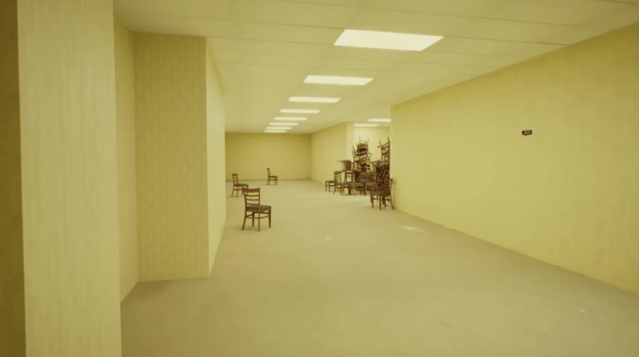
The Backrooms began as a single photograph. Posted to 4chan on May 14, 2019, accompanied by a short block of text. Beige wallpaper. Worn carpet. Fluorescent lights humming at a frequency that feels subtly wrong. A corridor that stretches in every direction with no doors, no windows, no exit. The text read, in part: if you are not careful and you noclip out of reality in the wrong areas, you will end up in the Backrooms. That is it. That is where it began. What grew from it was a mythology shaped entirely by the internet — by thousands of people adding rooms, rules, creatures, lore. The Backrooms is not one place. It is a space that expands to contain whatever fear you bring to it. Kane Parsons built his own version. His YouTube series — posted to the channel Kane Pixels beginning in January 2022 — frames the Backrooms as a real phenomenon, documented by a government research agency called ASync. The series is filmed as found footage: grainy, institutional, without dialogue. It is deeply unsettling in a way that has very little to do with monsters. Parsons has said that this film exists within the same universe and timeline as his YouTube series. If you wish to enter that world before watching, his channel is here: Kane Pixels — YouTube: https://www.youtube.com/@kanepixels A note: the series is dialogue-free found footage, institutional and cold in tone. It is very different from the film. Enter slowly.
The Story — Spoilers Included
The film is set in the 1990s. Clark (Chiwetel Ejiofor) once wanted to be an architect. He is not one. He runs a pirate-themed furniture store called Captain Clark’s Ottoman Empire, drinks too much, and is recently divorced. His life has the shape of a man who made too many concessions to a world that did not notice. One day, he finds a strange passage in the back of his store. He steps through. He begins mapping the Backrooms alone — obsessively, quietly, like a man who has finally found a project worthy of his abandoned ambition. He tells his therapist, Dr. Mary Kline, what he has found. She does not believe him. So Clark goes back. He convinces his employees Bobbi and Kat to come with him — extra pay, he promises. Proof, he needs. Something goes wrong.
Dr. Mary Kline (Renate Reinsve) carries a small stone. A piece of concrete with a handprint pressed into it — hers and her mother Nora’s, made together when she was a child. Nora suffered from paranoid delusions. She covered the windows with newspaper. She hid from the world and took her daughter with her into that hiding. Mary became a therapist. She walks into the Backrooms to find Clark. She finds something else first.
Phil (Mark Duplass) is a researcher at ASync. He believes the Backrooms is the greatest discovery in human history. He is mapping it. He is calm about everything. He is the most frightening person in the film.
The ending does not close. The room Mary escapes into — the one that looks like safety, like home — may simply be another room the Backrooms has constructed from her memories. The door opens. The film ends. You sit with it.
What the Film Is Really Saying
The Backrooms is not about a place. It is about what happens when a person stops fighting to find their way back. Clark is not consumed by a monster from outside. He is consumed by the decision to stay — to stop wanting the life he lost, to let this strange nowhere become ordinary. The entity that takes him does not arrive from the darkness. It arrives from the moment he chooses comfort over return. Mary’s stone is her past made physical. Her mother’s handprint beside her own. The weight of a childhood spent beside someone who could not distinguish the world from her fear of it. The stone must break before Mary can fight. The past must be held — and then released. Phil is modern numbness given a name and a salary. He is not evil. He is simply unbothered by something that should be terrifying. The film suggests, quietly, that this is its own kind of disappearance. The film’s lines — “every place that has ever existed,” “the result of distorted memory,” “the window inside” — point in the same direction. The Backrooms is not a dimension you fall into. It is what the mind builds when it has been left alone with its own distortions for too long. The film does not explain this. It trusts you to find it. For the generation that grew up inside this mythology — the teenagers who filled the theater around me — that trust probably felt like recognition. For those of us who arrived without the map, it felt more like standing outside a room where everyone else already knew the language.
What I Actually Felt
The theater was full. I cannot remember the last time I saw that. The teenagers around me were quiet in the way people are quiet when something is holding them. Not bored. Held. I was less held. Not because the film is bad. It is not bad. The production is genuinely extraordinary — a set of over 30,000 square feet was built for filming in Vancouver, large enough that crew members reportedly got lost inside it. The atmosphere is patient and strange in the way that good dread should be. And the performances, particularly Ejiofor’s slow unraveling and Reinsve’s careful stillness, give the film a human weight that its concept alone could not carry. But I kept feeling the gap. The space and the story did not quite breathe together. The symbols arrived and departed without fully connecting to the people in the room. I understood what the film was reaching for. I could not always feel it reaching. There is a particular frustration in a film that opens everything and explains nothing — not because openness is wrong, but because openness without warmth can feel like abandonment. The film gestures toward big things. It trusts the audience to close the distance. Sometimes that trust is generous. Sometimes it reads as impatience. The film is rated R in the United States. In Korea, audiences 15 and older can watch it. But its psychological weight — paranoid delusion, the dissolution of self, the specific despair of a life that did not become what it was supposed to — sits heavier than either rating fully suggests. I found myself wondering what this film might have been if it had been permitted to go further. Stranger. Harder. Less concerned with landing safely. Perhaps that is Kane Parsons’ next film. I will watch it.
A Final Note
The Backrooms is, at its core, a film about the danger of accepting the wrong place as home. Clark does not die fighting. He dies settling. That is the thing that stayed with me, long after the lights came up and the teenagers filed out talking fast and loud and alive. Not the monsters. Not the maze. The settling.
Published: June 2026 Film: The Backrooms (2026) | Director: Kane Parsons | Screenplay: Will Soodik Distributor: A24 | Rating: R (US) | Runtime: 105 minutes Production: Atomic Monster · 21 Laps Entertainment · Chernin Entertainment Cast: Chiwetel Ejiofor · Renate Reinsve · Mark Duplass · Finn Bennett · Lukita Maxwell Korean Distribution: By4M Studio · Revive Contents
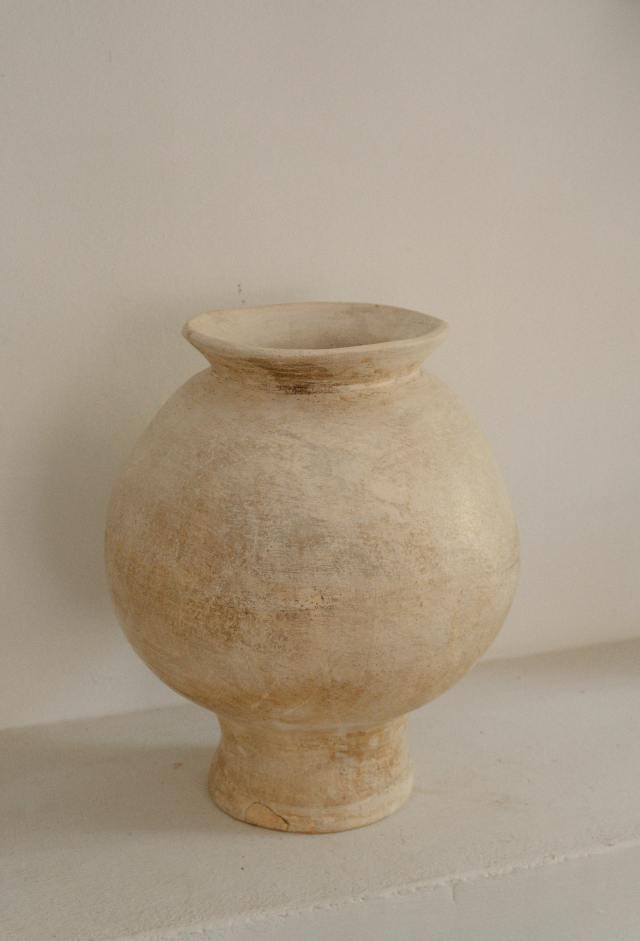
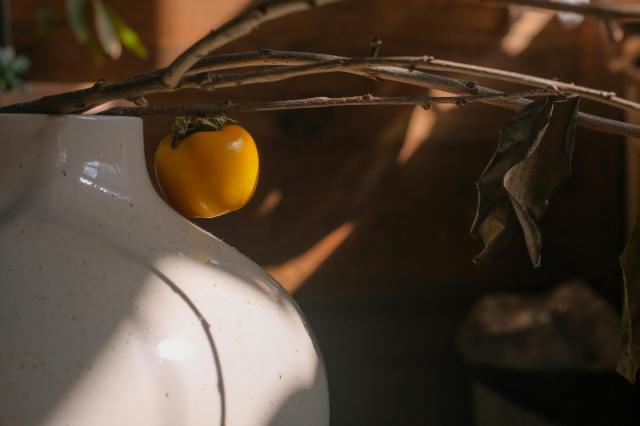
Each is thrown separately on the wheel — wide, open, almost flat. When both halves are ready, the potter turns one upside down and presses the rims together, clay against clay, while the body is still soft enough to yield. The seam is smoothed, but the belly remembers. It settles into its own weight, tilts slightly, breathes into an imperfect oval.
This was never corrected. In Joseon Korea, where moon jars were made during the 17th and 18th centuries, the slight asymmetry was simply left as it was. The quality sought was not precision, but presence.
The name comes from the glow. Place a moon jar where afternoon light can find it — the white glaze shifts, warms, becomes less like a surface and more like something held from within. Not the white of paper or paint. Closer to the sky in the hour before dawn.
Today, moon jars are held in the collections of the British Museum, the Victoria and Albert Museum in London, and the National Museum of Korea, among others. Ceramicists and designers worldwide have studied them, spent time with them, been quietly changed by them. The painter Kim Whanki kept one in his New York studio. He said it held everything — the full moon, the whiteness of snow, the stillness of a clear morning.
Some objects ask nothing of you except that you stay a little longer.
What a Korean drama taught me about the feelings we carry, the words we cannot find, and the weight that quietly stays.
Essay · Korean Drama · Netflix · May 2026
I want to tell you about a scene.
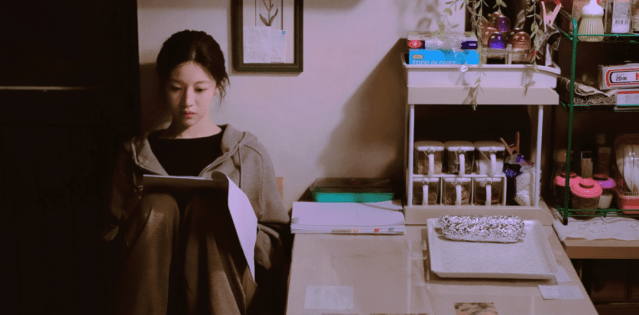
A woman is alone in her kitchen at night. The overhead light is off. The only light comes from a small lamp beneath the cabinet — that particular kind of low, amber warmth that exists in the space between being awake and being somewhere else entirely. She is holding a screenplay. Maybe reading it. Maybe just holding it the way we sometimes hold something when our hands need to be busy while our mind travels somewhere it has not been in a very long time.
And in the quiet of that kitchen, she thinks:
When I was in love, everything was easy.
When love left — the things I thought had disappeared, the things I was certain I had finally moved past — they were still there.
They had never gone anywhere at all.
This enormous, crushing, wordless inability to move.
It had just been waiting.
I have returned to this scene more than once. Not because it is the most dramatic moment in Everyone Is Fighting Their Own Worthlessness — it isn’t. There are louder scenes, more visually striking scenes, scenes dense with confrontation and revelation. But this one — this woman, this dim kitchen, this quiet and devastating realization — is the one I keep coming back to. Because it describes something I have never seen described so precisely, in any language, in any form.
Love does not fix us. It covers over what was already there. And when love lifts — as it eventually always does — we are left standing face to face with the weight we had genuinely believed, in our best moments, we had finally escaped.
About This Drama
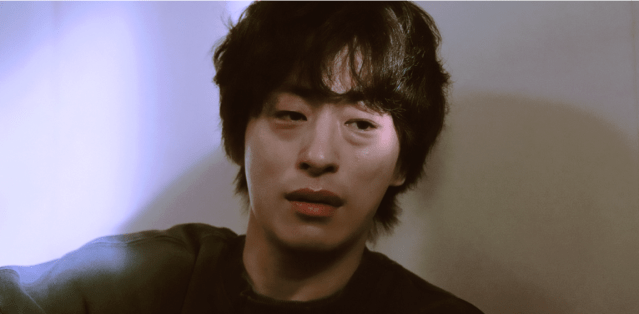
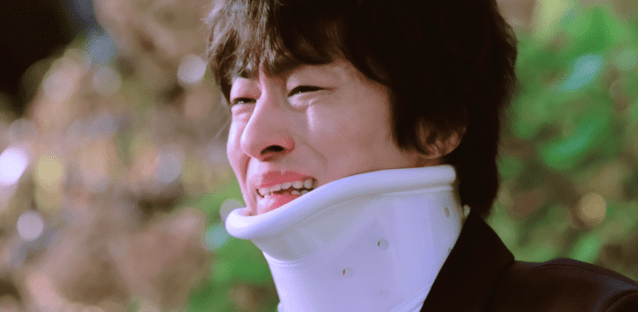
Everyone Is Fighting Their Own Worthlessness (모두가 자신의 무가치함과 싸우고 있다) is a JTBC and Netflix drama that aired in South Korea from April to May 2026. It was written by Park Hae-young, whose previous work — My Mister (2018) and My Liberation Notes (2022) — established her as one of the most precise and emotionally honest writers working in Korean television today. It stars Goo Gyo-hwan as Hwang Dong-man, Ko Yoon-jung as Byeon Eun-ah, Oh Jung-se as Park Kyung-se, Kang Mal-geum as Ko Hye-jin, Park Hae-joon as Hwang Jin-man, Bae Jong-ok as Oh Jung-hee, Han Sun-hwa as Jang Mi-ran, and Choi Won-young as Choi Dong-hyun.
On its surface, it is about a man who has spent twenty years trying and failing to become a film director. Beneath the surface, it is about something far more universal: the invisible weight that almost every person carries, the way that weight gets misread as inadequacy or failure, and what it actually means — slowly, imperfectly, at great personal cost — to begin to live alongside it rather than being destroyed by it.
I am writing this because I believe this drama deserves to be seen beyond Korea. Because its questions are not Korean questions. They are human questions. And because there are people reading this, in whatever country, in whatever language, who will recognize every single feeling described in what follows — even if, until now, they have never had the words for it.
The Weight That Does Not Go Away
I want to introduce a Korean word: 무기력 (mugireok).
In English, it is often translated as helplessness, or inertia, or lethargy. But each translation loses something essential about what the word actually feels like from the inside. The prefix mu (무) means absence — it negates, it empties out. Giryeok (기력) means energy, vitality, the internal force that propels a person through their life. So mugireok is not being blocked. It is not running into a wall. It is reaching for the energy to move and discovering that the energy is simply not there. Not obstructed. Absent. An emptiness where the will used to be.
Byeon Eun-ah’s mugireok is 무지막지한 — a word that describes something so disproportionate, so far beyond rational limits, occupying every available space within a person, that there is no clean English equivalent for its scale. The closest I can manage is this: an inability to move so complete that it stops feeling like an absence and begins to feel like a presence. Like something that has taken up residence.
And the thing that makes her realization in that dim kitchen so precise and so painful is this: she had believed it was gone.
When love arrived, she could move again. She could create, function, make decisions, begin her mornings without the immediate weight of being herself. She could breathe with something that felt like ease. And so she had naturally, reasonably concluded that the mugireok had lifted. That something in her had genuinely healed.
But it had not healed. It had found something warm to hide beneath.
Love, when it surrounds us, makes the colder regions of our inner life temporarily invisible. Not absent. Not resolved. Simply covered — held quiet, waiting with a patience that needs no particular urgency, because it has nowhere else to go and nothing else to become.
And when the warmth leaves, the cold returns. And in the cold, everything that was waiting becomes visible again. Not new. Not worse than before. Just uncovered. Exactly as it had always been.
This is what Eun-ah discovers in her kitchen: the mugireok did not come back. It never left. She had simply been given enough light, for a while, that she could not see it.
What We Misread As Failure
Hwang Dong-man has spent twenty years at what feels like the starting line. He belongs to a group of eight friends who once stood at the same place — all of them sharing the same dream, the same starting conditions, the same unformed futures. One by one, the others have crossed into the world of people who have made things, been recognized, acquired a professional identity. Dong-man has not.
The world looks at this and reaches for the most available explanation: failure. Deficiency. Some essential quality — discipline, or talent, or ambition — that he simply does not possess in sufficient quantity.
But the drama, slowly and without sentimentality, shows us something different.
Dong-man is not lazy. He is not without talent. He is not broken in the way the world assumes when it observes a person who has been in the same place for twenty years. He is someone who carries something heavy — something invisible — that makes every step cost more than it should. Something that means the same amount of visible effort that carries other people forward carries him, exhausted, back to nearly the same place he started.
The world has no instruments for weighing invisible burdens. So it reads the situation through the only lens it has: the ledger of visible achievement. And by that ledger, Dong-man is deficient. A man who has had every opportunity and made nothing of them. A man who, by the available evidence, does not want it enough.
This misreading — this catastrophic gap between what a person is actually carrying and what the world can observe — is, I believe, the true subject of this drama. Not failure. Not worthlessness. But the way that gap, over years and decades, becomes a person’s entire understanding of their own value. The way a misreading, when it is repeated often enough by the world and eventually by the person themselves, calcifies into something that feels indistinguishable from fact.
Dong-man has been misread for twenty years. And somewhere along the way, he began to misread himself in exactly the same way.
A Device That Asks an Honest Question
One of the drama’s more unusual elements is a wearable device called the 감정 워치 — the emotion watch. Worn on the wrist, it reads the wearer’s current emotional state and displays it as a word. Anger. Excitement. Anxiety. Hunger.
And sometimes: 알 수 없음. Unknown.
The device is not the drama’s most important element, but it carries one of its most important questions. Because for Dong-man, 알 수 없음 appears with a particular frequency. Not because he is without feelings — he has enormous feelings — but because those feelings exist at a depth or in a complexity that has not yet resolved into the category of something nameable.
At one point in the drama, Byeon Eun-ah attempts to describe what 알 수 없음 actually contains for him:
“It is the feeling of wanting to self-destruct — but not quite anger, and not quite despair. Something with about seven percent of desperate longing mixed in.”
Hearing this, Dong-man realizes something for the first time. That what the watch had been registering as unknown was, at its core, two words he had never once been able to say out loud.
Help me.
They had been there the whole time — curled up in the space where the language should have been. The watch had called them unknown not because they did not exist, but because they had never been allowed to surface into words. For twenty years, a man had been carrying a cry for help so deep inside himself that his own body could not identify it.
The drama’s internal monologue at this moment is something I have not been able to forget:
“The words I retrieved from diving so deep — the words I found in order to reach you — those words retrieved me first.”
He had gone looking for the language to understand someone else. And in finding it, he found himself.
The Person Who Said Good
There is a conversation at the center of this drama that I want to give you in full, because I do not think a summary can do it justice.
Dong-man says to Eun-ah: “I have the feeling. I just cannot explain it.”
She answers: “Good.”
He is visibly confused. He tells her she is the first person who has ever responded to those words with anything other than frustration, or impatience, or an implicit expectation that he try harder.
She continues: “For people who feel compelled to explain everything, saying ‘I cannot explain it’ must be terrifying. But the person who cannot explain — that is when my eyes open. Of course you cannot explain it. How do you contain an abstract feeling inside concrete, controlled language?”
He finishes her thought: “The gap between abstract feeling and concrete language.”
She closes it: “Those two — no matter how many times you zigzag between them — there is no point where they meet.”
I want to stay with this for a moment.
Most of us have grown up inside cultures that treat the ability to articulate one’s inner life as a measure of maturity, or emotional intelligence, or general competence. The person who can explain their feelings clearly is treated as someone who has their interior life in order. The person who cannot — who says “I don’t know how to put it” or “it’s difficult to explain” or simply goes quiet and hopes that their silence carries something — is treated as someone still in the process of becoming fully functional.
This assumption is so widely held, and so rarely examined, that many of us have never thought to question it. We have only experienced its consequences: the shame of not being able to find the words. The exhaustion of trying to force into language something that exists at a level beneath language. The particular loneliness of watching another person respond to an approximation of what you felt — the version that made it through the translation — as though they have understood you, when you know, quietly, that what they understood was a simplified and somewhat distorted copy of the original.
What Eun-ah says turns this assumption entirely inside out.
The feeling that resists language is not the confused feeling. It is often the realest one — the feeling that exists closest to the actual truth of a person’s experience, before that truth has been processed and compressed and made safe enough to hand to another person. To be unable to explain a feeling is not to be behind or deficient. It may simply mean that you are in close proximity to something that predates language — something that has always existed, in every human being, in a register that words can approach but never fully reach.
And what Eun-ah gives Dong-man by saying good is something no one has ever given him before: permission to be exactly where he is. Not a more articulate version of himself. Not someone who has already found the words. Just here. With the unnamed feeling and the twenty years of carrying it. Met, precisely, where he actually stands.
That single response — good — changes something in him. Not because it solves anything. But because it is the first time in twenty years that someone has met him at the edge of the gap, rather than asking him to close it first.
For Anyone Who Feels Too Much
I want to speak directly now, for a moment, to a particular kind of person.
The person who has always felt things more intensely than the surrounding circumstances seem to require. Who moves through the world absorbing more than others appear to absorb — the shifts in a room’s emotional weather, the unspoken weight in someone else’s silence, the residue of a difficult conversation that others seem to shake off within hours and that you are still carrying three days later. Who has been told, in various ways and various tones, to calm down. Not to take things so personally. Not to be so sensitive.
Who has spent years trying to figure out how to feel less — or at least how to feel less visibly — because the feelings, at their natural intensity, seem to be more than the world knows what to do with.
To you, this drama says something rare and something true.
Feeling things differently is not the same as feeling things wrongly.
The internal noise that you carry — the emotional volume that is always slightly louder than what the situation officially warrants — is not a malfunction. It is not evidence of immaturity or instability. It is, more likely, evidence that you process experience at a depth and with an attention that is genuinely different from shallower processing, and that the standard ways of measuring a person — the visible outcomes, the professional accomplishments, the ability to explain oneself clearly and move on — simply were not designed to account for what it costs to be someone like you.
This does not make the weight lighter. The weight is still heavy. The misreadings still happen. The gap between what you feel and what you can say still yawns open at the worst possible moments, in the middle of conversations with people you love, when you most need to be understood and least have the language to make yourself understood.
But there is a difference — a crucial difference — between carrying that weight and being defined by it. Between experiencing difficulty and interpreting that difficulty as proof of fundamental worthlessness. The drama is about the long, hard, imperfect process of learning that difference. And it insists, quietly but with great conviction, that the process is possible.
How to Begin to Understand Your Own Feelings
One of the things I find most valuable in this drama — beyond its emotional honesty, beyond its performances, beyond the quality of its writing — is the way it models what it actually looks like to approach your own inner life with curiosity rather than judgment.
Dong-man’s mugireok, his 알 수 없음, his inability to explain what he feels — these are not treated as problems to be corrected. They are treated as information. As a landscape to be explored. As something that, when approached with enough patience and enough of the right kind of attention, will eventually yield the words it contains.
This matters because most of us have been taught to approach our uncomfortable emotions as problems to be solved or suppressed as quickly as possible. We feel something difficult and immediately reach for the tool that will make it stop — distraction, rationalization, the company of other people, the absorption of the self into work or activity or noise. Anything to avoid sitting with the feeling long enough for it to tell us what it actually is.
What the drama suggests — through the device of the emotion watch, through Eun-ah’s willingness to sit with Dong-man in his unnamed feelings, through the entire arc of his story — is that the feelings we cannot name are precisely the ones that most deserve our attention. Not because feeling them is pleasant. It is not. But because they are carrying information that the louder, more manageable surface of our daily life has been successfully drowning out for years.
The mugireok that Eun-ah discovers in her kitchen is not her enemy. It is the part of her that has been waiting, with perfect patience, for the conditions under which she can finally be seen. The feeling that Dong-man calls 알 수 없음 is not confusion — it is depth. It is the location where the most important truth about his situation has been living, waiting for someone to hand it the words it needed.
To sit with a difficult feeling — without immediately trying to fix it, explain it away, or perform the version of yourself that does not have it — is one of the most demanding things a human being can do. And one of the most necessary.
The Poem a Poet Left Behind
There is a poem in this drama. It belongs to Hwang Jin-man — Dong-man’s older brother, played by Park Hae-joon.
Jin-man was a poet of extraordinary gifts. And then his child died. In the wreckage of that loss, in the most devastated period of his life, he made a discovery that he could not forgive himself for: even there, even in the complete destruction of grief, some part of him was still reaching toward language. Still noticing the specific quality of the light. Still finding images and rhythms and the particular music of feeling pressed into words. The poet inside him did not pause for the death of his child. He could not make it pause. He could not make it have the decency to go quiet out of respect for the magnitude of what had happened.
He interpreted this as evidence of something fundamentally cold in his nature. Something that should not be forgiven. A man who could lose a child and still, somewhere deep down, be a poet — that kind of man did not deserve to continue writing. So he silenced the poet himself. He stopped writing entirely. He chose silence as a form of punishment for the crime of being, at his irreducible core, someone who turns experience into language.
The poem that is read aloud in the drama is from before the silence. It is called A Fault Buried Somewhere — 어딘가 묻어있는 잘못.
I washed my face.It did not wash off.
I trimmed my nails.There is something that cannot be trimmed.
I wrung the wet rag and wiped the floor.It does not wipe clean.
A fault buried somewhere . . . . . a fault . . . . .
The poem does not reach for grand metaphors or the elevated language of tragedy. It does not announce its subject. It simply describes: a person, performing the ordinary acts of ordinary hygiene and maintenance. Face. Nails. Floor. The things we do without thinking, every day, because they are part of keeping the surfaces of our lives clean. And then, quietly and repeatedly, the same discovery: it is not working. Whatever needs to be cleaned is not located on the surface.
This is the architecture of shame. Not guilt — guilt is about what you did, and guilt can in principle be addressed through action, through apology, through making something right. Shame operates differently. Shame is a belief about what you are. It is not located in your behavior, which means it cannot be corrected through changing your behavior. It lives somewhere deeper — in the bedrock understanding of your own fundamental nature — and no surface-level cleaning will reach it.
Jin-man silenced the poet because he believed that being a poet at the moment of his child’s death was proof of a deficiency in his nature — not in what he had done, but in what he essentially was. He could not change what he was. So he punished it instead. He buried it. And carried the buried thing, like a fault pressed permanently into a floor that the cloth keeps passing over without touching.
I think about all the people who have done some version of this. Not writers. All of us. The parts of ourselves we have silenced — not because they were wrong, but because we could not find a way to forgive them for existing. The sensitivity that was too much for someone we loved. The need that felt like weakness. The feeling that arrived at the wrong time in the wrong size and that we buried as quickly as possible, and have been carrying the burial of ever since.
Everyone. Already.
The title of this drama is not Hwang Dong-man Is Fighting His Own Worthlessness.
It is Everyone Is Fighting Their Own Worthlessness.
This is not a small difference. It is the entire point.
Park Kyung-se, played by Oh Jung-se, has directed five films. By any observable measurement, he is a success. He is also one of the most tormented people in the drama — a man consumed by jealousy, self-comparison, and an existential fragility that five films have done almost nothing to address. If anything, the success has made the weight harder to examine. Because now he is expected, even by himself, to have moved past such things. And so the weight goes underground, and expresses itself sideways: in the way he treats Dong-man, in the particular cruelty of the person who has achieved something and cannot stop comparing himself to someone who hasn’t, because somewhere beneath the achievement he suspects the difference between them may be smaller than it appears.
Oh Jung-hee, played by Bae Jong-ok, is a beloved national actress — the highest position anyone in this world can occupy. And behind that name, behind the recognition and the decades of work, is a stacked accumulation of old wounds and quiet guilts that all the adoration in the world has not dissolved.
Byeon Eun-ah is brilliant and precise and professionally formidable. And she has been carrying the memory of being nine years old and abandoned since she was nine years old and abandoned. Every time someone leaves — not conceptually, but in her body, in the floor of her nervous system — she returns to that age. That feeling. The mugireok that she discovers in her kitchen is not a recent development. It is the thing that has been there since she was a small child in an impossible situation, waiting beneath every good thing she has ever built.
What the drama is doing, across all of these characters and all of their varying levels of visible success, is making a single careful argument: the internal experience of worthlessness does not follow the external logic of achievement. It is not distributed according to what you have or have not accomplished. It does not resolve when you finally get the thing you spent years believing would resolve it. It lives inside human experience in a way that success cannot reliably reach and failure does not uniquely produce.
This is an act of solidarity written into the title itself. The word everyone reaches across every line that normally divides the successful from the struggling — and says: I see you on both sides. You are not as different from each other as you think. You are each, in your own way, already fighting.
The Gap, and What to Do With It
I want to say one more thing to anyone who has ever tried to tell someone they love how they were feeling, and found the words coming out wrong. Too flat, or too dramatic, or missing the actual point by just enough that the other person nodded and tried to help, but was clearly helping with a slightly different problem than the one you were actually inside of.
The gap is real.
The gap between what we feel and what language can carry — it is structural, it is permanent, and it does not close simply because both people are trying hard and loving each other sincerely. It is not a failure of communication. It is not a sign that either person is inadequate. It is the condition of being a human being whose inner life exists at a depth that language can approach, with great effort and some beauty, but never fully reach.
Most of the loneliness that quietly accumulates inside long-term relationships and close friendships — I have come to believe this more steadily over time — is not the loneliness of being unloved. It is the loneliness of standing on one side of this gap, calling out, and having the person you love call back, and realizing that what each of you is hearing is slightly, crucially different from what the other intended to send. Not because either of you is failing. Simply because the gap is real, and wide, and has always been there.
What this drama offers is not a solution to this. There is no solution. But it offers something almost more valuable than a solution: acknowledgment. It says: yes, this is real. The gap exists. You are not failing at being human. You are experiencing the irreducible complexity of having feelings that language was never fully equipped to carry.
And it says: the right person — the person whose eyes open when you say “I cannot explain it” — will not demand that you close the gap before they meet you. They will come to the edge of it, stand where you are standing, and say: good. Of course you cannot explain it. Tell me what you can.
안온함 — Anon-ham — A Wish For Something Softer Than Happiness
Near the end of the drama, a character expresses a wish for Byeon Eun-ah. That her life will be filled with 안온함 — anon-ham.
I have spent time trying to find an English word that carries this meaning fully. I have not succeeded, and I think that failure is itself instructive.
Tranquility is too still — it suggests the absence of difficulty, which is not what this word means. Contentment is too satisfied — it suggests arrival, completion. Peace is too resolute. Comfort is too soft. Anon-ham is something more fragile and more honest than any of these. It is something like: the particular warmth of a life that has, at long last, stopped spending all of its energy on proving itself or escaping itself. A quietness that arrives not because the hard things are gone, but because a person has slowly, imperfectly, at genuine cost, learned to sit beside them without being consumed by them.
It is not a wish for everything to be fixed.
It is a wish for everything to be livable.
And I have been sitting with the difference between those two things. Because fixed is a violent kind of hope — it asks the person to become different, to have their pain resolved, to arrive somewhere past the hard things and remain there permanently. Livable is something quieter and more patient. It says: I do not need you to be healed. I need you to be able to breathe. I need the weight to thin enough that other things can exist alongside it.
The mugireok does not vanish when the right person arrives. The gap between feeling and language does not close when you are finally understood. The fault buried somewhere does not wash off no matter how long you stand at the sink.
But maybe — slowly, at an unpredictable pace, in ways that cannot be planned or forced — it thins.
Maybe the weight becomes something you carry differently, rather than something that carries you.
Maybe the kitchen at night, with only the amber light under the cabinet, stops being only the place where the hardest things become visible — and becomes, sometimes, the place where you can sit with them without being destroyed. Where you can acknowledge, quietly, that they were always there. That they have not gone anywhere. And that you are still here too. Still present. Still, somehow, managing.
That is anon-ham. A life that can be lived as it actually is.
The drama says that is enough.
I believe it too.
사랑할 때는 모든 게 쉬었어요.사랑이 떠나고 나면 — 어디로 안 갔구나.이 무지막지한 무기력.
When I was loved, everything was easy.When love left — it had never gone anywhere at all.This enormous, wordless inability to move.It had just been waiting.
Everyone Is Fighting Their Own Worthlessness모두가 자신의 무가치함과 싸우고 있다 JTBC · Netflix Written by Park Hae-young · Directed by Cha Young-hoon Starring Goo Gyo-hwan · Ko Yoon-jung · Oh Jung-se · Kang Mal-geum Park Hae-joon · Bae Jong-ok · Han Sun-hwa · Choi Won-young April 18 – May 24, 2026 · 12 episodes Now streaming on Netflix
There is a word in Korean that has no equivalent in English.
Linguists have tried. Attachment. Affection. Bond. None of them are quite right. The word is 정 — romanized as Jeong — and it describes something that grows between people not through grand gestures or declared love, but through time. Through proximity. Through the accumulation of small, unremarkable moments that somehow, quietly, become everything.
How Jeong forms.
You do not decide to feel Jeong. It arrives without announcement. It is the feeling for the neighbor you have argued with for twenty years — and would still bring soup to if they were sick. It is the attachment to a place you left long ago, that pulls at something unnamed when you pass by it. It is the bond between people who have shared difficulty — not because the difficulty was beautiful, but because they were present for each other inside it. Jeong does not require that you like someone. It requires only that you have been with them. Long enough. Closely enough. For something to take root.
The paradox of Jeong.
There is a phrase in Korean: 정 때문에 못 떠난다. I cannot leave because of Jeong. It can mean staying in a relationship that no longer serves you. In a job. In a city. In a friendship that has faded but never quite ended. Jeong is not always comfortable. It is not always chosen. Sometimes it is simply what remains after everything else has been reconsidered. This is what makes it so honest — and so difficult to explain to someone who grew up with a different word for love.
Jeong and the things we keep.
I think about Jeong when I look at objects that should have been thrown away. A cup with a chip in the rim. A worn-out bag. A plant that has been repotted so many times it barely resembles what it once was. We do not keep these things because they are beautiful. We keep them because something accumulated between us and them — some quantity of mornings, of ordinary use, of time. That is Jeong, too. It seeps into objects the same way it seeps into people. Slowly. Without asking permission.
A last thought.
The name of this blog — shimiiru — means to seep in. I chose it because I believe the things that matter most do not arrive all at once. They seep. Slowly. Quietly. Into everything. 정 is exactly that. The feeling you didn’t notice forming until the day you realized you could not imagine its absence. Thank you for reading shimiiru this week. See you again on Monday.
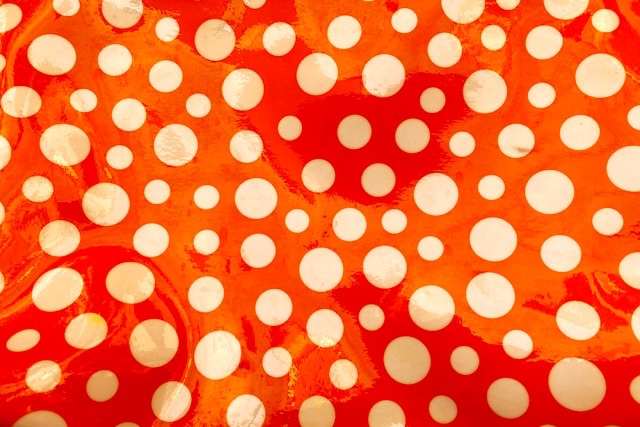
Before the dots, there was something she needed to escape.
Yayoi Kusama was born on March 22, 1929, in Matsumoto, Japan. As a child, she began to see things. Flowers that spoke to her. Patterns that pulsed and multiplied. A world that seemed to dissolve at its edges into endless repetition. She picked up a pencil. She drew what she saw. And she never really stopped.
What the dots actually are.
People see Kusama’s work and think: playful. Joyful. And it is all of those things. But the dots began as something else entirely — a way of neutralizing the hallucinations that had followed her since childhood. By painting what she feared, she found she could contain it. She called this process self-obliteration — the dissolving of the self into the pattern, until the anxiety had nowhere left to go. The dots were not decoration. They were survival.
New York. The 1960s. Nobody took her seriously.
Kusama moved to New York in 1958. She was a young Japanese woman in an art world dominated by men. She organized happenings. She made soft sculptures. She created room-sized installations when the word installation barely existed. Ideas that would later define contemporary art — the immersive environment, the infinity room, the participatory artwork — she was doing them first, with almost no recognition. She returned to Japan in 1973, largely forgotten by the West.
The return. The recognition.
Decades later, the art world caught up. The Infinity Mirror Rooms — chambers lined with mirrors and LED lights, reflecting her dots into an endless, disorienting universe — became some of the most visited artworks of the 21st century. People waited hours. They wept inside them. She was in her eighties when this happened. She had been making the work for sixty years.
She still goes to the studio every day.
Since 1977, Kusama has lived voluntarily in a psychiatric facility in Tokyo. Every morning, she walks across the street to her studio. She paints. In 2026, she is 97 years old. She is still one of the most productive artists alive. There is something in that — in a person who found the one thing that quieted the noise, and simply never stopped doing it.
Why she matters beyond the photograph.
It is easy to reduce Kusama to a backdrop. To the yellow pumpkins. To the mirror rooms. To the dots on everything. But look at the full arc of her life and you see something else: A woman who was told, repeatedly, that her vision was too much — too obsessive, too feminine, too foreign, too strange — who kept going anyway. Who turned what frightened her into what defined her. That is not a brand. That is a life.
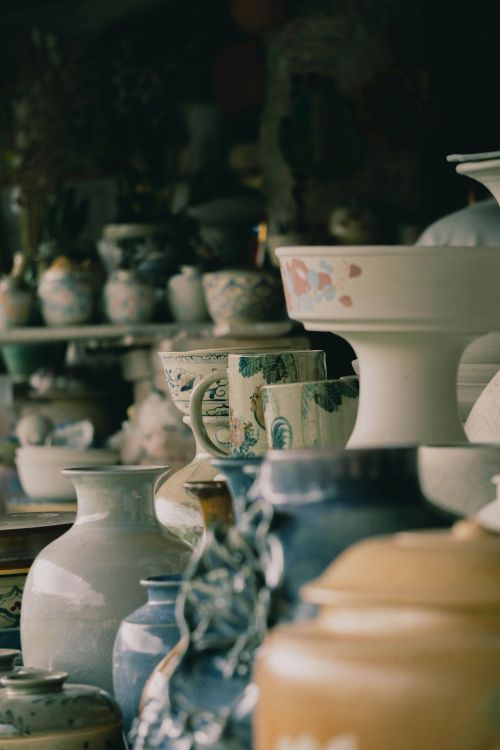
There is a Korean ceramic tradition that the Western art world took centuries to notice. Not because it was hidden. But because its beauty asked something unusual of the viewer — the willingness to find grace in what is uneven, unpolished, and quietly alive.
It is called Buncheong.
What is Buncheong?
Buncheong (분청사기) emerged in Korea during the early Joseon Dynasty, in the 15th century. It grew from the ashes of Goryeo celadon — a more refined, aristocratic tradition. What replaced it was something looser. More human.
Potters began coating dark clay with white slip — a liquid mixture of fine clay and water — then carving, stamping, or brushing patterns into the surface before it dried.
The result was never perfectly symmetrical. Never without variation. And that, it turns out, was exactly the point.
Why Japan fell in love with it first.
In the 15th and 16th centuries, Japanese tea masters discovered Buncheong bowls. They used them in tea ceremonies — not despite their imperfections, but because of them.
The philosophy of finding beauty in the incomplete found its ideal vessel in a Korean potter’s everyday bowl.
There is something quietly ironic about this. The bowls were ordinary objects in Korea. Functional. Unremarkable. And yet they became treasured objects in another culture’s highest ritual.
What makes a Buncheong bowl beautiful?
Look closely at one and you will notice:
The white slip is never perfectly even. The brush marks are visible — sometimes bold, sometimes hesitant. The stamp patterns repeat, but never exactly. The glaze pools differently in each curve.
It is a record of a hand moving through clay. Of a specific morning in a specific workshop, centuries ago. No two are the same. That is not a flaw. That is the whole conversation.
A last thought.
We live in a time of surfaces that are optimized, filtered, corrected. Buncheong asks a different question —
What if the mark left by the making is the most honest part of the thing?
That question, it turns out, never goes out of style.