In Korean dramas, the Busan dialect has a role it did not audition for.
If you have watched a Korean drama with subtitles, you may not have noticed the dialect. The subtitles translate the meaning, not the sound, and the particular way someone from Busan speaks tends to disappear into the English equivalent of “he’s angry” or “she’s threatening him.” But Korean viewers notice immediately. The Busan dialect — 사투리, saturi, a word that means regional accent or dialect — is one of the most recognizable in the country, and its associations in popular culture have become a kind of running character type. You know it when you hear it, and you know what character is about to do.
What the Dialect Actually Sounds Like
Standard Korean — the form taught in schools, spoken on news broadcasts, and associated with Seoul — has a relatively flat intonation. Sentences tend to end in a predictable pitch pattern. The rhythm is measured. The Gyeongsang dialect, which includes the Busan accent, works differently. It is characterized by a rising and falling pitch that can make statements sound, to an unaccustomed ear, like questions or assertions of particular emphasis. The rhythm is faster and more clipped. Certain sentence endings that are common in Seoul Korean — the softening particles, the polite hedging — are compressed or dropped entirely. The dialect sounds, from the outside, direct. Sometimes blunt. Sometimes, depending on who you ask, aggressive. In Busan specifically, there are features that people who grow up here absorb without thinking about: words that contract in particular ways, expressions that do not exist in the standard form, and the general quality of the speech that carries the city’s particular character. Locals often say that Busan speech sounds warmer and more open than outsiders perceive it — that the directness comes from comfort and confidence rather than hostility, and that it reads as harsh only to people who are not used to it. This distinction — between how the dialect sounds to someone from Busan and how it sounds to someone from Seoul — sits at the center of a cultural phenomenon that has shaped the Busan accent’s reputation on screen.
The Casting Problem
In Korean dramas and films, the Gyeongsang dialect — and the Busan dialect specifically — has been used as a consistent shorthand for a particular character type. The powerful villain who speaks in a low, rough accent from the south. The crime boss whose authority is communicated partly by how he sounds. The enforcer whose threats feel more physical when delivered in the Busan dialect’s particular cadence. This is not an invented association. It developed over decades of Korean media, during which Gyeongsang dialect became linked with strength, toughness, and often moral ambiguity in ways that standard Korean was not. Some of Korea’s most memorable screen villains speak with an accent from this region. The association became self-reinforcing: the dialect is used for a certain kind of character, and so audiences come to expect that kind of character when they hear the dialect. The pattern is not unique to Korea. Regional dialects in almost every country carry associations that their speakers did not choose and often find reductive. People from the American South, from certain parts of England, from particular regions of France — all deal with versions of the same phenomenon, where the sound of where you come from carries an attached narrative that lives in other people’s minds. For people from Busan, the character type can be amusing, sometimes flattering in a particular way, and sometimes genuinely tiring. The city is not primarily organized around the things its dialect represents on screen. It is a city of four million people with the full range of personalities, occupations, and ways of being in the world. The fact that a particular sound marks you as coming from here tells viewers very little about who you actually are.
When Dialect Functions as Identity
There is another side to the Busan accent’s profile that the villain-casting narrative tends to obscure. Within Busan — and in conversations between people who share the accent — the dialect is a form of recognition and belonging. You hear someone speak and you immediately know they are from here, or have lived here long enough that the city has changed how they talk. This matters in a country where regional identity is real and where the difference between how someone sounds in Busan and how someone sounds in Seoul is immediately noticeable. The accent also softens significantly depending on context. Busan speakers who move to Seoul for work often find themselves automatically code-switching — moderating the accent, adopting more standard patterns, returning to the fuller dialect when they come back. This is a common experience across many regional speech communities, and it reflects the quiet social pressure toward the standard form that exists in most centralized countries. The capital’s speech becomes neutral; everything else is marked. People who grew up in Busan and live here now speak the dialect most fully in casual conversation — with family, with old friends, in the market, in the places where no one is watching or evaluating how you sound. This is when the language is most itself. The self that it reveals is not the crime boss from a drama. It is something considerably more ordinary, and more genuinely Busan, than that.
The Phrase That Carries a City
오이소, 보이소, 사이소 — the phrase from Jagalchi Market that means come, see, buy — is written in standard Korean romanization as a kind of curiosity, but in the Busan dialect, the sounds and the rhythm are specific. It is not how you would say those words in Seoul. The compression, the speed, the particular shape of each word — these are features of the dialect and features of the city at the same time. Linguists study saturi as one of several surviving regional Korean dialects, each with its own grammatical patterns and phonological characteristics that developed over centuries of relative geographic separation. The Gyeongsang dialect family, of which Busan speech is a member, is considered distinct enough from standard Korean to be genuinely challenging for learners working from Seoul-based textbooks. People from Busan tend to know this and take a quiet pride in it. The dialect is theirs. The casting decisions are television’s. The two things have always been separate, whatever the credits might suggest.
What a Korean drama taught me about the feelings we carry, the words we cannot find, and the weight that quietly stays.
Essay · Korean Drama · Netflix · May 2026
I want to tell you about a scene.
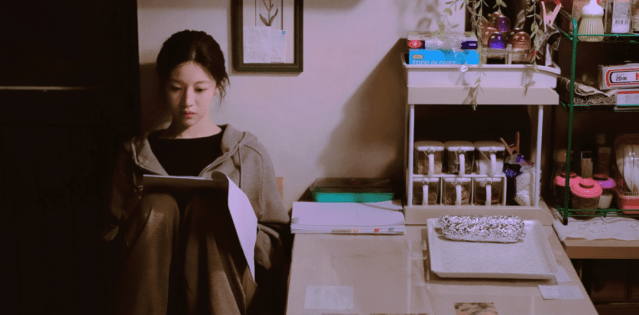
A woman is alone in her kitchen at night. The overhead light is off. The only light comes from a small lamp beneath the cabinet — that particular kind of low, amber warmth that exists in the space between being awake and being somewhere else entirely. She is holding a screenplay. Maybe reading it. Maybe just holding it the way we sometimes hold something when our hands need to be busy while our mind travels somewhere it has not been in a very long time.
And in the quiet of that kitchen, she thinks:
When I was in love, everything was easy.
When love left — the things I thought had disappeared, the things I was certain I had finally moved past — they were still there.
They had never gone anywhere at all.
This enormous, crushing, wordless inability to move.
It had just been waiting.
I have returned to this scene more than once. Not because it is the most dramatic moment in Everyone Is Fighting Their Own Worthlessness — it isn’t. There are louder scenes, more visually striking scenes, scenes dense with confrontation and revelation. But this one — this woman, this dim kitchen, this quiet and devastating realization — is the one I keep coming back to. Because it describes something I have never seen described so precisely, in any language, in any form.
Love does not fix us. It covers over what was already there. And when love lifts — as it eventually always does — we are left standing face to face with the weight we had genuinely believed, in our best moments, we had finally escaped.
About This Drama
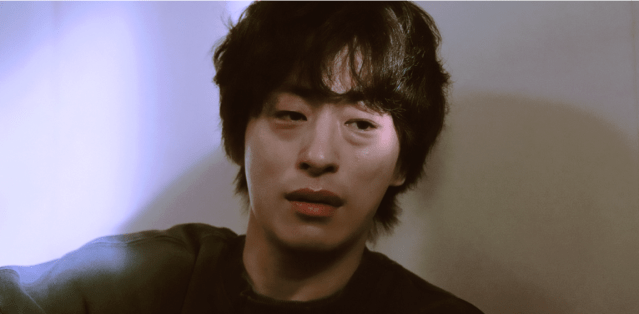
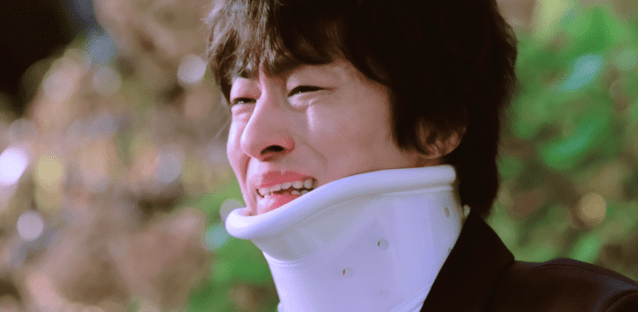
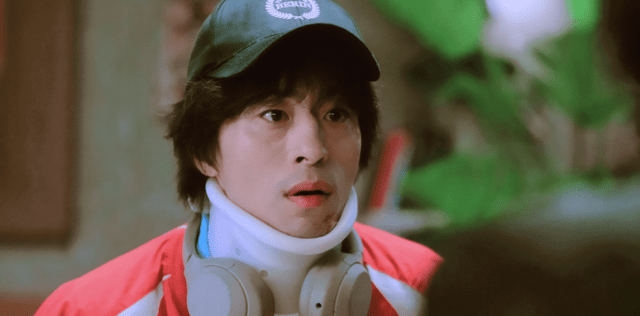
Everyone Is Fighting Their Own Worthlessness (모두가 자신의 무가치함과 싸우고 있다) is a JTBC and Netflix drama that aired in South Korea from April to May 2026. It was written by Park Hae-young, whose previous work — My Mister (2018) and My Liberation Notes (2022) — established her as one of the most precise and emotionally honest writers working in Korean television today. It stars Goo Gyo-hwan as Hwang Dong-man, Ko Yoon-jung as Byeon Eun-ah, Oh Jung-se as Park Kyung-se, Kang Mal-geum as Ko Hye-jin, Park Hae-joon as Hwang Jin-man, Bae Jong-ok as Oh Jung-hee, Han Sun-hwa as Jang Mi-ran, and Choi Won-young as Choi Dong-hyun.
On its surface, it is about a man who has spent twenty years trying and failing to become a film director. Beneath the surface, it is about something far more universal: the invisible weight that almost every person carries, the way that weight gets misread as inadequacy or failure, and what it actually means — slowly, imperfectly, at great personal cost — to begin to live alongside it rather than being destroyed by it.
I am writing this because I believe this drama deserves to be seen beyond Korea. Because its questions are not Korean questions. They are human questions. And because there are people reading this, in whatever country, in whatever language, who will recognize every single feeling described in what follows — even if, until now, they have never had the words for it.
The Weight That Does Not Go Away
I want to introduce a Korean word: 무기력 (mugireok).
In English, it is often translated as helplessness, or inertia, or lethargy. But each translation loses something essential about what the word actually feels like from the inside. The prefix mu (무) means absence — it negates, it empties out. Giryeok (기력) means energy, vitality, the internal force that propels a person through their life. So mugireok is not being blocked. It is not running into a wall. It is reaching for the energy to move and discovering that the energy is simply not there. Not obstructed. Absent. An emptiness where the will used to be.
Byeon Eun-ah’s mugireok is 무지막지한 — a word that describes something so disproportionate, so far beyond rational limits, occupying every available space within a person, that there is no clean English equivalent for its scale. The closest I can manage is this: an inability to move so complete that it stops feeling like an absence and begins to feel like a presence. Like something that has taken up residence.
And the thing that makes her realization in that dim kitchen so precise and so painful is this: she had believed it was gone.
When love arrived, she could move again. She could create, function, make decisions, begin her mornings without the immediate weight of being herself. She could breathe with something that felt like ease. And so she had naturally, reasonably concluded that the mugireok had lifted. That something in her had genuinely healed.
But it had not healed. It had found something warm to hide beneath.
Love, when it surrounds us, makes the colder regions of our inner life temporarily invisible. Not absent. Not resolved. Simply covered — held quiet, waiting with a patience that needs no particular urgency, because it has nowhere else to go and nothing else to become.
And when the warmth leaves, the cold returns. And in the cold, everything that was waiting becomes visible again. Not new. Not worse than before. Just uncovered. Exactly as it had always been.
This is what Eun-ah discovers in her kitchen: the mugireok did not come back. It never left. She had simply been given enough light, for a while, that she could not see it.
What We Misread As Failure
Hwang Dong-man has spent twenty years at what feels like the starting line. He belongs to a group of eight friends who once stood at the same place — all of them sharing the same dream, the same starting conditions, the same unformed futures. One by one, the others have crossed into the world of people who have made things, been recognized, acquired a professional identity. Dong-man has not.
The world looks at this and reaches for the most available explanation: failure. Deficiency. Some essential quality — discipline, or talent, or ambition — that he simply does not possess in sufficient quantity.
But the drama, slowly and without sentimentality, shows us something different.
Dong-man is not lazy. He is not without talent. He is not broken in the way the world assumes when it observes a person who has been in the same place for twenty years. He is someone who carries something heavy — something invisible — that makes every step cost more than it should. Something that means the same amount of visible effort that carries other people forward carries him, exhausted, back to nearly the same place he started.
The world has no instruments for weighing invisible burdens. So it reads the situation through the only lens it has: the ledger of visible achievement. And by that ledger, Dong-man is deficient. A man who has had every opportunity and made nothing of them. A man who, by the available evidence, does not want it enough.
This misreading — this catastrophic gap between what a person is actually carrying and what the world can observe — is, I believe, the true subject of this drama. Not failure. Not worthlessness. But the way that gap, over years and decades, becomes a person’s entire understanding of their own value. The way a misreading, when it is repeated often enough by the world and eventually by the person themselves, calcifies into something that feels indistinguishable from fact.
Dong-man has been misread for twenty years. And somewhere along the way, he began to misread himself in exactly the same way.
A Device That Asks an Honest Question
One of the drama’s more unusual elements is a wearable device called the 감정 워치 — the emotion watch. Worn on the wrist, it reads the wearer’s current emotional state and displays it as a word. Anger. Excitement. Anxiety. Hunger.
And sometimes: 알 수 없음. Unknown.
The device is not the drama’s most important element, but it carries one of its most important questions. Because for Dong-man, 알 수 없음 appears with a particular frequency. Not because he is without feelings — he has enormous feelings — but because those feelings exist at a depth or in a complexity that has not yet resolved into the category of something nameable.
At one point in the drama, Byeon Eun-ah attempts to describe what 알 수 없음 actually contains for him:
“It is the feeling of wanting to self-destruct — but not quite anger, and not quite despair. Something with about seven percent of desperate longing mixed in.”
Hearing this, Dong-man realizes something for the first time. That what the watch had been registering as unknown was, at its core, two words he had never once been able to say out loud.
Help me.
They had been there the whole time — curled up in the space where the language should have been. The watch had called them unknown not because they did not exist, but because they had never been allowed to surface into words. For twenty years, a man had been carrying a cry for help so deep inside himself that his own body could not identify it.
The drama’s internal monologue at this moment is something I have not been able to forget:
“The words I retrieved from diving so deep — the words I found in order to reach you — those words retrieved me first.”
He had gone looking for the language to understand someone else. And in finding it, he found himself.
The Person Who Said Good
There is a conversation at the center of this drama that I want to give you in full, because I do not think a summary can do it justice.
Dong-man says to Eun-ah: “I have the feeling. I just cannot explain it.”
She answers: “Good.”
He is visibly confused. He tells her she is the first person who has ever responded to those words with anything other than frustration, or impatience, or an implicit expectation that he try harder.
She continues: “For people who feel compelled to explain everything, saying ‘I cannot explain it’ must be terrifying. But the person who cannot explain — that is when my eyes open. Of course you cannot explain it. How do you contain an abstract feeling inside concrete, controlled language?”
He finishes her thought: “The gap between abstract feeling and concrete language.”
She closes it: “Those two — no matter how many times you zigzag between them — there is no point where they meet.”
I want to stay with this for a moment.
Most of us have grown up inside cultures that treat the ability to articulate one’s inner life as a measure of maturity, or emotional intelligence, or general competence. The person who can explain their feelings clearly is treated as someone who has their interior life in order. The person who cannot — who says “I don’t know how to put it” or “it’s difficult to explain” or simply goes quiet and hopes that their silence carries something — is treated as someone still in the process of becoming fully functional.
This assumption is so widely held, and so rarely examined, that many of us have never thought to question it. We have only experienced its consequences: the shame of not being able to find the words. The exhaustion of trying to force into language something that exists at a level beneath language. The particular loneliness of watching another person respond to an approximation of what you felt — the version that made it through the translation — as though they have understood you, when you know, quietly, that what they understood was a simplified and somewhat distorted copy of the original.
What Eun-ah says turns this assumption entirely inside out.
The feeling that resists language is not the confused feeling. It is often the realest one — the feeling that exists closest to the actual truth of a person’s experience, before that truth has been processed and compressed and made safe enough to hand to another person. To be unable to explain a feeling is not to be behind or deficient. It may simply mean that you are in close proximity to something that predates language — something that has always existed, in every human being, in a register that words can approach but never fully reach.
And what Eun-ah gives Dong-man by saying good is something no one has ever given him before: permission to be exactly where he is. Not a more articulate version of himself. Not someone who has already found the words. Just here. With the unnamed feeling and the twenty years of carrying it. Met, precisely, where he actually stands.
That single response — good — changes something in him. Not because it solves anything. But because it is the first time in twenty years that someone has met him at the edge of the gap, rather than asking him to close it first.
For Anyone Who Feels Too Much
I want to speak directly now, for a moment, to a particular kind of person.
The person who has always felt things more intensely than the surrounding circumstances seem to require. Who moves through the world absorbing more than others appear to absorb — the shifts in a room’s emotional weather, the unspoken weight in someone else’s silence, the residue of a difficult conversation that others seem to shake off within hours and that you are still carrying three days later. Who has been told, in various ways and various tones, to calm down. Not to take things so personally. Not to be so sensitive.
Who has spent years trying to figure out how to feel less — or at least how to feel less visibly — because the feelings, at their natural intensity, seem to be more than the world knows what to do with.
To you, this drama says something rare and something true.
Feeling things differently is not the same as feeling things wrongly.
The internal noise that you carry — the emotional volume that is always slightly louder than what the situation officially warrants — is not a malfunction. It is not evidence of immaturity or instability. It is, more likely, evidence that you process experience at a depth and with an attention that is genuinely different from shallower processing, and that the standard ways of measuring a person — the visible outcomes, the professional accomplishments, the ability to explain oneself clearly and move on — simply were not designed to account for what it costs to be someone like you.
This does not make the weight lighter. The weight is still heavy. The misreadings still happen. The gap between what you feel and what you can say still yawns open at the worst possible moments, in the middle of conversations with people you love, when you most need to be understood and least have the language to make yourself understood.
But there is a difference — a crucial difference — between carrying that weight and being defined by it. Between experiencing difficulty and interpreting that difficulty as proof of fundamental worthlessness. The drama is about the long, hard, imperfect process of learning that difference. And it insists, quietly but with great conviction, that the process is possible.
How to Begin to Understand Your Own Feelings
One of the things I find most valuable in this drama — beyond its emotional honesty, beyond its performances, beyond the quality of its writing — is the way it models what it actually looks like to approach your own inner life with curiosity rather than judgment.
Dong-man’s mugireok, his 알 수 없음, his inability to explain what he feels — these are not treated as problems to be corrected. They are treated as information. As a landscape to be explored. As something that, when approached with enough patience and enough of the right kind of attention, will eventually yield the words it contains.
This matters because most of us have been taught to approach our uncomfortable emotions as problems to be solved or suppressed as quickly as possible. We feel something difficult and immediately reach for the tool that will make it stop — distraction, rationalization, the company of other people, the absorption of the self into work or activity or noise. Anything to avoid sitting with the feeling long enough for it to tell us what it actually is.
What the drama suggests — through the device of the emotion watch, through Eun-ah’s willingness to sit with Dong-man in his unnamed feelings, through the entire arc of his story — is that the feelings we cannot name are precisely the ones that most deserve our attention. Not because feeling them is pleasant. It is not. But because they are carrying information that the louder, more manageable surface of our daily life has been successfully drowning out for years.
The mugireok that Eun-ah discovers in her kitchen is not her enemy. It is the part of her that has been waiting, with perfect patience, for the conditions under which she can finally be seen. The feeling that Dong-man calls 알 수 없음 is not confusion — it is depth. It is the location where the most important truth about his situation has been living, waiting for someone to hand it the words it needed.
To sit with a difficult feeling — without immediately trying to fix it, explain it away, or perform the version of yourself that does not have it — is one of the most demanding things a human being can do. And one of the most necessary.
The Poem a Poet Left Behind
There is a poem in this drama. It belongs to Hwang Jin-man — Dong-man’s older brother, played by Park Hae-joon.
Jin-man was a poet of extraordinary gifts. And then his child died. In the wreckage of that loss, in the most devastated period of his life, he made a discovery that he could not forgive himself for: even there, even in the complete destruction of grief, some part of him was still reaching toward language. Still noticing the specific quality of the light. Still finding images and rhythms and the particular music of feeling pressed into words. The poet inside him did not pause for the death of his child. He could not make it pause. He could not make it have the decency to go quiet out of respect for the magnitude of what had happened.
He interpreted this as evidence of something fundamentally cold in his nature. Something that should not be forgiven. A man who could lose a child and still, somewhere deep down, be a poet — that kind of man did not deserve to continue writing. So he silenced the poet himself. He stopped writing entirely. He chose silence as a form of punishment for the crime of being, at his irreducible core, someone who turns experience into language.
The poem that is read aloud in the drama is from before the silence. It is called A Fault Buried Somewhere — 어딘가 묻어있는 잘못.
I washed my face.It did not wash off.
I trimmed my nails.There is something that cannot be trimmed.
I wrung the wet rag and wiped the floor.It does not wipe clean.
A fault buried somewhere . . . . . a fault . . . . .
The poem does not reach for grand metaphors or the elevated language of tragedy. It does not announce its subject. It simply describes: a person, performing the ordinary acts of ordinary hygiene and maintenance. Face. Nails. Floor. The things we do without thinking, every day, because they are part of keeping the surfaces of our lives clean. And then, quietly and repeatedly, the same discovery: it is not working. Whatever needs to be cleaned is not located on the surface.
This is the architecture of shame. Not guilt — guilt is about what you did, and guilt can in principle be addressed through action, through apology, through making something right. Shame operates differently. Shame is a belief about what you are. It is not located in your behavior, which means it cannot be corrected through changing your behavior. It lives somewhere deeper — in the bedrock understanding of your own fundamental nature — and no surface-level cleaning will reach it.
Jin-man silenced the poet because he believed that being a poet at the moment of his child’s death was proof of a deficiency in his nature — not in what he had done, but in what he essentially was. He could not change what he was. So he punished it instead. He buried it. And carried the buried thing, like a fault pressed permanently into a floor that the cloth keeps passing over without touching.
I think about all the people who have done some version of this. Not writers. All of us. The parts of ourselves we have silenced — not because they were wrong, but because we could not find a way to forgive them for existing. The sensitivity that was too much for someone we loved. The need that felt like weakness. The feeling that arrived at the wrong time in the wrong size and that we buried as quickly as possible, and have been carrying the burial of ever since.
Everyone. Already.
The title of this drama is not Hwang Dong-man Is Fighting His Own Worthlessness.
It is Everyone Is Fighting Their Own Worthlessness.
This is not a small difference. It is the entire point.
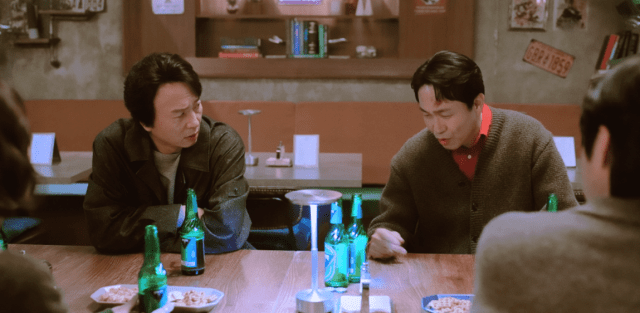
Park Kyung-se, played by Oh Jung-se, has directed five films. By any observable measurement, he is a success. He is also one of the most tormented people in the drama — a man consumed by jealousy, self-comparison, and an existential fragility that five films have done almost nothing to address. If anything, the success has made the weight harder to examine. Because now he is expected, even by himself, to have moved past such things. And so the weight goes underground, and expresses itself sideways: in the way he treats Dong-man, in the particular cruelty of the person who has achieved something and cannot stop comparing himself to someone who hasn’t, because somewhere beneath the achievement he suspects the difference between them may be smaller than it appears.
Oh Jung-hee, played by Bae Jong-ok, is a beloved national actress — the highest position anyone in this world can occupy. And behind that name, behind the recognition and the decades of work, is a stacked accumulation of old wounds and quiet guilts that all the adoration in the world has not dissolved.
Byeon Eun-ah is brilliant and precise and professionally formidable. And she has been carrying the memory of being nine years old and abandoned since she was nine years old and abandoned. Every time someone leaves — not conceptually, but in her body, in the floor of her nervous system — she returns to that age. That feeling. The mugireok that she discovers in her kitchen is not a recent development. It is the thing that has been there since she was a small child in an impossible situation, waiting beneath every good thing she has ever built.
What the drama is doing, across all of these characters and all of their varying levels of visible success, is making a single careful argument: the internal experience of worthlessness does not follow the external logic of achievement. It is not distributed according to what you have or have not accomplished. It does not resolve when you finally get the thing you spent years believing would resolve it. It lives inside human experience in a way that success cannot reliably reach and failure does not uniquely produce.
This is an act of solidarity written into the title itself. The word everyone reaches across every line that normally divides the successful from the struggling — and says: I see you on both sides. You are not as different from each other as you think. You are each, in your own way, already fighting.
The Gap, and What to Do With It
I want to say one more thing to anyone who has ever tried to tell someone they love how they were feeling, and found the words coming out wrong. Too flat, or too dramatic, or missing the actual point by just enough that the other person nodded and tried to help, but was clearly helping with a slightly different problem than the one you were actually inside of.
The gap is real.
The gap between what we feel and what language can carry — it is structural, it is permanent, and it does not close simply because both people are trying hard and loving each other sincerely. It is not a failure of communication. It is not a sign that either person is inadequate. It is the condition of being a human being whose inner life exists at a depth that language can approach, with great effort and some beauty, but never fully reach.
Most of the loneliness that quietly accumulates inside long-term relationships and close friendships — I have come to believe this more steadily over time — is not the loneliness of being unloved. It is the loneliness of standing on one side of this gap, calling out, and having the person you love call back, and realizing that what each of you is hearing is slightly, crucially different from what the other intended to send. Not because either of you is failing. Simply because the gap is real, and wide, and has always been there.
What this drama offers is not a solution to this. There is no solution. But it offers something almost more valuable than a solution: acknowledgment. It says: yes, this is real. The gap exists. You are not failing at being human. You are experiencing the irreducible complexity of having feelings that language was never fully equipped to carry.
And it says: the right person — the person whose eyes open when you say “I cannot explain it” — will not demand that you close the gap before they meet you. They will come to the edge of it, stand where you are standing, and say: good. Of course you cannot explain it. Tell me what you can.
안온함 — Anon-ham — A Wish For Something Softer Than Happiness
Near the end of the drama, a character expresses a wish for Byeon Eun-ah. That her life will be filled with 안온함 — anon-ham.
I have spent time trying to find an English word that carries this meaning fully. I have not succeeded, and I think that failure is itself instructive.
Tranquility is too still — it suggests the absence of difficulty, which is not what this word means. Contentment is too satisfied — it suggests arrival, completion. Peace is too resolute. Comfort is too soft. Anon-ham is something more fragile and more honest than any of these. It is something like: the particular warmth of a life that has, at long last, stopped spending all of its energy on proving itself or escaping itself. A quietness that arrives not because the hard things are gone, but because a person has slowly, imperfectly, at genuine cost, learned to sit beside them without being consumed by them.
It is not a wish for everything to be fixed.
It is a wish for everything to be livable.
And I have been sitting with the difference between those two things. Because fixed is a violent kind of hope — it asks the person to become different, to have their pain resolved, to arrive somewhere past the hard things and remain there permanently. Livable is something quieter and more patient. It says: I do not need you to be healed. I need you to be able to breathe. I need the weight to thin enough that other things can exist alongside it.
The mugireok does not vanish when the right person arrives. The gap between feeling and language does not close when you are finally understood. The fault buried somewhere does not wash off no matter how long you stand at the sink.
But maybe — slowly, at an unpredictable pace, in ways that cannot be planned or forced — it thins.
Maybe the weight becomes something you carry differently, rather than something that carries you.
Maybe the kitchen at night, with only the amber light under the cabinet, stops being only the place where the hardest things become visible — and becomes, sometimes, the place where you can sit with them without being destroyed. Where you can acknowledge, quietly, that they were always there. That they have not gone anywhere. And that you are still here too. Still present. Still, somehow, managing.
That is anon-ham. A life that can be lived as it actually is.
The drama says that is enough.
I believe it too.
사랑할 때는 모든 게 쉬었어요.사랑이 떠나고 나면 — 어디로 안 갔구나.이 무지막지한 무기력.
When I was loved, everything was easy.When love left — it had never gone anywhere at all.This enormous, wordless inability to move.It had just been waiting.
Everyone Is Fighting Their Own Worthlessness모두가 자신의 무가치함과 싸우고 있다 JTBC · Netflix Written by Park Hae-young · Directed by Cha Young-hoon Starring Goo Gyo-hwan · Ko Yoon-jung · Oh Jung-se · Kang Mal-geum Park Hae-joon · Bae Jong-ok · Han Sun-hwa · Choi Won-young April 18 – May 24, 2026 · 12 episodes Now streaming on Netflix