2026 · PERSON · ART
Before the dots, there was something she needed to escape.
Yayoi Kusama was born on March 22, 1929, in Matsumoto, Japan.
As a child, she began to see things.
Flowers that spoke to her.
Patterns that pulsed and multiplied.
A world that seemed to dissolve at its edges into endless repetition.
She picked up a pencil. She drew what she saw.
And she never really stopped.
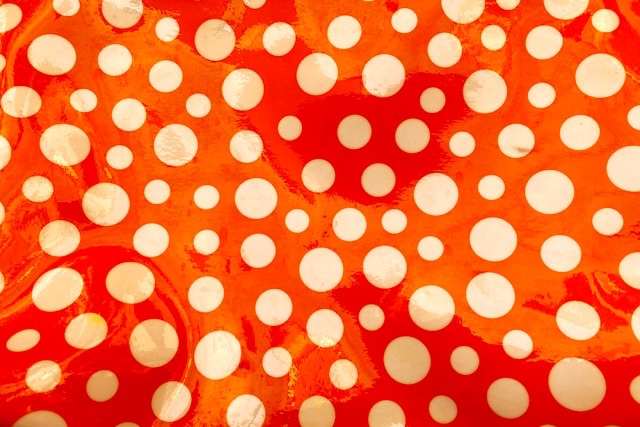
What the dots actually are.
People see Kusama’s work and think: playful. Joyful.
And it is all of those things.
But the dots began as something else entirely —
a way of neutralizing the hallucinations that had followed her since childhood.
By painting what she feared, she found she could contain it.
She called this process self-obliteration —
the dissolving of the self into the pattern,
until the anxiety had nowhere left to go.
The dots were not decoration. They were survival.
New York. The 1960s. Nobody took her seriously.
Kusama moved to New York in 1958.
She was a young Japanese woman in an art world dominated by men.
She organized happenings. She made soft sculptures.
She created room-sized installations when the word installation barely existed.
Ideas that would later define contemporary art —
the immersive environment, the infinity room, the participatory artwork —
she was doing them first, with almost no recognition.
She returned to Japan in 1973, largely forgotten by the West.
The return. The recognition.
Decades later, the art world caught up.
The Infinity Mirror Rooms — chambers lined with mirrors and LED lights,
reflecting her dots into an endless, disorienting universe —
became some of the most visited artworks of the 21st century.
People waited hours. They wept inside them.
She was in her eighties when this happened.
She had been making the work for sixty years.
She still goes to the studio every day.
Since 1977, Kusama has lived voluntarily in a psychiatric facility in Tokyo.
Every morning, she walks across the street to her studio.
She paints.
In 2026, she is 97 years old.
She is still one of the most productive artists alive.
There is something in that —
in a person who found the one thing that quieted the noise,
and simply never stopped doing it.
Why she matters beyond the photograph.
It is easy to reduce Kusama to a backdrop.
To the yellow pumpkins. To the mirror rooms. To the dots on everything.
But look at the full arc of her life and you see something else:
A woman who was told, repeatedly, that her vision was too much —
too obsessive, too feminine, too foreign, too strange —
who kept going anyway.
Who turned what frightened her into what defined her.
That is not a brand. That is a life.

