There is a word I keep returning to, the way a tongue finds a sore tooth — not to hurt itself, but because the ache confirms something is still there. Certainty. In Korean, we say hwaksin — 확신. Literally: to believe firmly. To hold something in your chest without loosening your grip. It sounds simple. People say it easily, the way they say of course or trust me. But I have lived long enough to know that certainty is not a given. It is a practice. And some of us were never taught how.
I used to think the loneliness I felt came from being alone. But I have sat beside people — close enough to feel their warmth — and felt the cold more sharply than if I had been in an empty room. That is the particular cruelty of relational loneliness: it offers proximity and withholds presence. You are not abandoned. You are simply unseen. And there is no clean word for that in any language, because the grief of it is too quiet to name. When someone repeats things to you — small, careful things that land like stones — and your mind begins to agree with them, that is not weakness. That is the human nervous system doing what it was designed to do: finding pattern, adapting, surviving. But survival and truth are not the same thing. And when you cannot tell the difference between what you actually feel and what you have been taught to feel, certainty becomes a foreign country you once visited but can no longer find on any map.
I have wondered, more than once, whether the fault was mine. Most of us have. It is easier to locate the problem inside ourselves than to sit with the unsettling possibility that the world around us simply asked too much and explained too little. But here is what I am slowly learning: Certainty does not arrive all at once. It does not knock at the door with its name written on a card. It comes the way light enters a room — not dramatically, not all at once, but through the smallest gap. A moment when you notice that your body relaxes and you don’t know why. A morning when the weight is still there but you carry it differently. A quiet recognition: that was not fair, and I did not deserve it. That recognition — however late, however small — is the beginning of certainty.
Philosophers have long argued about the nature of the self. Descartes distilled it to thought: I think, therefore I am. But I think the more honest version might be this: I feel, and I notice that I feel, and in that noticing — I am. Because awareness is not nothing. The moment you can observe your own pain from a small distance — not to dismiss it, but simply to say there it is, this is real, this belongs to me — something shifts. You are no longer only inside the wave. You are also standing on the shore, watching it. That distance is not detachment. It is the first gesture of self-trust.
I want to live by certainty. Not certainty about the world — the world is chaotic and largely indifferent and I have made peace with that. But certainty about myself. To know: this is what I value. To know: this is what I will not carry anymore. To know: my emotions are not the problem. They are the information. I do not have this yet. I am still practicing. Some days I am practicing well. Other days the wave comes and I forget I have ever stood on shore. And sometimes, quietly, I am afraid — afraid that certainty, once it finally arrives, might wear the heart smooth. That in learning to stand so steady, I will lose the very tenderness that let me feel this much in the first place. But I think — and this is perhaps the quietest, most radical thing I believe — I think that wanting certainty is itself a form of it. The longing to trust yourself means the self is still there, waiting. Unhurried. Patient. It has not given up on you. And that, for now, is enough to keep going.
A personal review — not a critic’s, just a person’s.
I am not a film critic. I walked into the theater alone, sat down among rows of teenagers, and watched. That is all.
What follows is simply what I felt, what I noticed, and what stayed with me after the lights came back on.
Before We Begin — What Is This Film? The Backrooms had its world premiere in Los Angeles on May 7, 2026. It opened in South Korea on May 27 — two days before its wide North American release on May 29. Distributed by A24. Directed by Kane Parsons. Written by Will Soodik. Co-produced by James Wan’s Atomic Monster, Shawn Levy’s 21 Laps Entertainment, and Chernin Entertainment. The film stars Chiwetel Ejiofor as Clark, Renate Reinsve as Dr. Mary Kline, Mark Duplass as Phil, Finn Bennett, and Lukita Maxwell. It runs 105 minutes and is rated R in the United States. The director is twenty years old. Kane Parsons was born June 18, 2005. At sixteen, he uploaded a found footage short to YouTube under the name Kane Pixels. It reached over 70 million views. He built every shot himself using Blender — a 3D graphics program — without formal training, without film school. He composed the music. He did all of it alone, in his room, as a teenager. At seventeen, A24 called. He became the youngest director in the studio’s history. The Backrooms grossed $81.5 million in North America in its opening weekend — the biggest opening in A24’s history. Worldwide, it earned $118 million.
It holds an 87% Certified Fresh rating on Rotten Tomatoes.
The Origin — What Are the Backrooms?
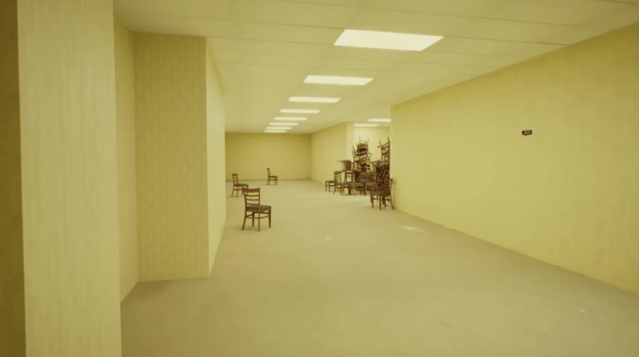
The Backrooms began as a single photograph. Posted to 4chan on May 14, 2019, accompanied by a short block of text. Beige wallpaper. Worn carpet. Fluorescent lights humming at a frequency that feels subtly wrong. A corridor that stretches in every direction with no doors, no windows, no exit. The text read, in part: if you are not careful and you noclip out of reality in the wrong areas, you will end up in the Backrooms. That is it. That is where it began. What grew from it was a mythology shaped entirely by the internet — by thousands of people adding rooms, rules, creatures, lore. The Backrooms is not one place. It is a space that expands to contain whatever fear you bring to it. Kane Parsons built his own version. His YouTube series — posted to the channel Kane Pixels beginning in January 2022 — frames the Backrooms as a real phenomenon, documented by a government research agency called ASync. The series is filmed as found footage: grainy, institutional, without dialogue. It is deeply unsettling in a way that has very little to do with monsters. Parsons has said that this film exists within the same universe and timeline as his YouTube series. If you wish to enter that world before watching, his channel is here: Kane Pixels — YouTube: https://www.youtube.com/@kanepixels A note: the series is dialogue-free found footage, institutional and cold in tone. It is very different from the film. Enter slowly.
The Story — Spoilers Included
The film is set in the 1990s. Clark (Chiwetel Ejiofor) once wanted to be an architect. He is not one. He runs a pirate-themed furniture store called Captain Clark’s Ottoman Empire, drinks too much, and is recently divorced. His life has the shape of a man who made too many concessions to a world that did not notice. One day, he finds a strange passage in the back of his store. He steps through. He begins mapping the Backrooms alone — obsessively, quietly, like a man who has finally found a project worthy of his abandoned ambition. He tells his therapist, Dr. Mary Kline, what he has found. She does not believe him. So Clark goes back. He convinces his employees Bobbi and Kat to come with him — extra pay, he promises. Proof, he needs. Something goes wrong.
Dr. Mary Kline (Renate Reinsve) carries a small stone. A piece of concrete with a handprint pressed into it — hers and her mother Nora’s, made together when she was a child. Nora suffered from paranoid delusions. She covered the windows with newspaper. She hid from the world and took her daughter with her into that hiding. Mary became a therapist. She walks into the Backrooms to find Clark. She finds something else first.
Phil (Mark Duplass) is a researcher at ASync. He believes the Backrooms is the greatest discovery in human history. He is mapping it. He is calm about everything. He is the most frightening person in the film.
The ending does not close. The room Mary escapes into — the one that looks like safety, like home — may simply be another room the Backrooms has constructed from her memories. The door opens. The film ends. You sit with it.
What the Film Is Really Saying
The Backrooms is not about a place. It is about what happens when a person stops fighting to find their way back. Clark is not consumed by a monster from outside. He is consumed by the decision to stay — to stop wanting the life he lost, to let this strange nowhere become ordinary. The entity that takes him does not arrive from the darkness. It arrives from the moment he chooses comfort over return. Mary’s stone is her past made physical. Her mother’s handprint beside her own. The weight of a childhood spent beside someone who could not distinguish the world from her fear of it. The stone must break before Mary can fight. The past must be held — and then released. Phil is modern numbness given a name and a salary. He is not evil. He is simply unbothered by something that should be terrifying. The film suggests, quietly, that this is its own kind of disappearance. The film’s lines — “every place that has ever existed,” “the result of distorted memory,” “the window inside” — point in the same direction. The Backrooms is not a dimension you fall into. It is what the mind builds when it has been left alone with its own distortions for too long. The film does not explain this. It trusts you to find it. For the generation that grew up inside this mythology — the teenagers who filled the theater around me — that trust probably felt like recognition. For those of us who arrived without the map, it felt more like standing outside a room where everyone else already knew the language.
What I Actually Felt
The theater was full. I cannot remember the last time I saw that. The teenagers around me were quiet in the way people are quiet when something is holding them. Not bored. Held. I was less held. Not because the film is bad. It is not bad. The production is genuinely extraordinary — a set of over 30,000 square feet was built for filming in Vancouver, large enough that crew members reportedly got lost inside it. The atmosphere is patient and strange in the way that good dread should be. And the performances, particularly Ejiofor’s slow unraveling and Reinsve’s careful stillness, give the film a human weight that its concept alone could not carry. But I kept feeling the gap. The space and the story did not quite breathe together. The symbols arrived and departed without fully connecting to the people in the room. I understood what the film was reaching for. I could not always feel it reaching. There is a particular frustration in a film that opens everything and explains nothing — not because openness is wrong, but because openness without warmth can feel like abandonment. The film gestures toward big things. It trusts the audience to close the distance. Sometimes that trust is generous. Sometimes it reads as impatience. The film is rated R in the United States. In Korea, audiences 15 and older can watch it. But its psychological weight — paranoid delusion, the dissolution of self, the specific despair of a life that did not become what it was supposed to — sits heavier than either rating fully suggests. I found myself wondering what this film might have been if it had been permitted to go further. Stranger. Harder. Less concerned with landing safely. Perhaps that is Kane Parsons’ next film. I will watch it.
A Final Note
The Backrooms is, at its core, a film about the danger of accepting the wrong place as home. Clark does not die fighting. He dies settling. That is the thing that stayed with me, long after the lights came up and the teenagers filed out talking fast and loud and alive. Not the monsters. Not the maze. The settling.
Published: June 2026 Film: The Backrooms (2026) | Director: Kane Parsons | Screenplay: Will Soodik Distributor: A24 | Rating: R (US) | Runtime: 105 minutes Production: Atomic Monster · 21 Laps Entertainment · Chernin Entertainment Cast: Chiwetel Ejiofor · Renate Reinsve · Mark Duplass · Finn Bennett · Lukita Maxwell Korean Distribution: By4M Studio · Revive Contents
There is a word in Korean that has no equivalent in English.
Linguists have tried. Attachment. Affection. Bond. None of them are quite right. The word is 정 — romanized as Jeong — and it describes something that grows between people not through grand gestures or declared love, but through time. Through proximity. Through the accumulation of small, unremarkable moments that somehow, quietly, become everything.
How Jeong forms.
You do not decide to feel Jeong. It arrives without announcement. It is the feeling for the neighbor you have argued with for twenty years — and would still bring soup to if they were sick. It is the attachment to a place you left long ago, that pulls at something unnamed when you pass by it. It is the bond between people who have shared difficulty — not because the difficulty was beautiful, but because they were present for each other inside it. Jeong does not require that you like someone. It requires only that you have been with them. Long enough. Closely enough. For something to take root.
The paradox of Jeong.
There is a phrase in Korean: 정 때문에 못 떠난다. I cannot leave because of Jeong. It can mean staying in a relationship that no longer serves you. In a job. In a city. In a friendship that has faded but never quite ended. Jeong is not always comfortable. It is not always chosen. Sometimes it is simply what remains after everything else has been reconsidered. This is what makes it so honest — and so difficult to explain to someone who grew up with a different word for love.
Jeong and the things we keep.
I think about Jeong when I look at objects that should have been thrown away. A cup with a chip in the rim. A worn-out bag. A plant that has been repotted so many times it barely resembles what it once was. We do not keep these things because they are beautiful. We keep them because something accumulated between us and them — some quantity of mornings, of ordinary use, of time. That is Jeong, too. It seeps into objects the same way it seeps into people. Slowly. Without asking permission.
A last thought.
The name of this blog — shimiiru — means to seep in. I chose it because I believe the things that matter most do not arrive all at once. They seep. Slowly. Quietly. Into everything. 정 is exactly that. The feeling you didn’t notice forming until the day you realized you could not imagine its absence. Thank you for reading shimiiru this week. See you again on Monday.
Before the dots, there was something she needed to escape.
Yayoi Kusama was born on March 22, 1929, in Matsumoto, Japan. As a child, she began to see things. Flowers that spoke to her. Patterns that pulsed and multiplied. A world that seemed to dissolve at its edges into endless repetition. She picked up a pencil. She drew what she saw. And she never really stopped.
What the dots actually are.
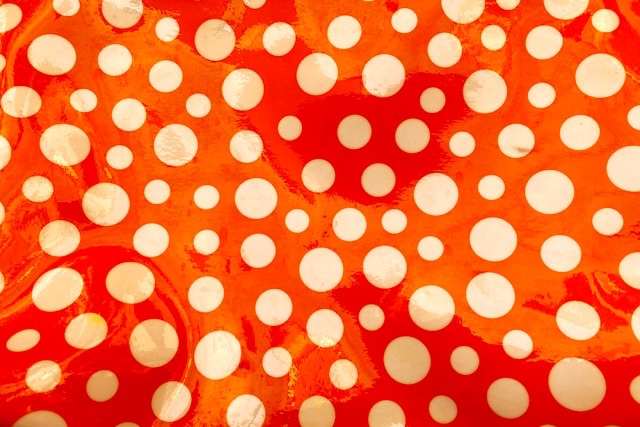
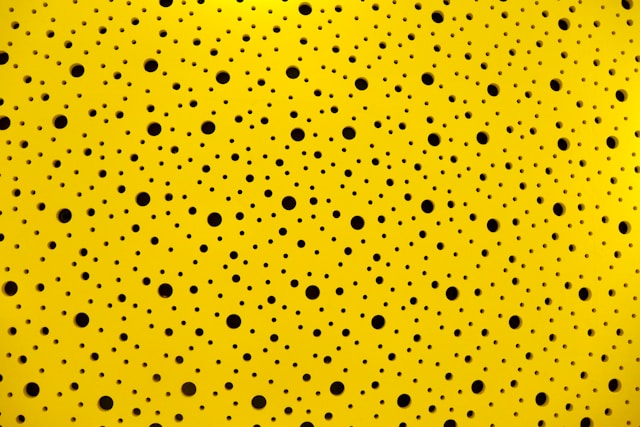
People see Kusama’s work and think: playful. Joyful. And it is all of those things. But the dots began as something else entirely — a way of neutralizing the hallucinations that had followed her since childhood. By painting what she feared, she found she could contain it. She called this process self-obliteration — the dissolving of the self into the pattern, until the anxiety had nowhere left to go. The dots were not decoration. They were survival.
New York. The 1960s. Nobody took her seriously.
Kusama moved to New York in 1958. She was a young Japanese woman in an art world dominated by men. She organized happenings. She made soft sculptures. She created room-sized installations when the word installation barely existed. Ideas that would later define contemporary art — the immersive environment, the infinity room, the participatory artwork — she was doing them first, with almost no recognition. She returned to Japan in 1973, largely forgotten by the West.
The return. The recognition.
Decades later, the art world caught up. The Infinity Mirror Rooms — chambers lined with mirrors and LED lights, reflecting her dots into an endless, disorienting universe — became some of the most visited artworks of the 21st century. People waited hours. They wept inside them. She was in her eighties when this happened. She had been making the work for sixty years.
She still goes to the studio every day.
Since 1977, Kusama has lived voluntarily in a psychiatric facility in Tokyo. Every morning, she walks across the street to her studio. She paints. In 2026, she is 97 years old. She is still one of the most productive artists alive. There is something in that — in a person who found the one thing that quieted the noise, and simply never stopped doing it.
Why she matters beyond the photograph.
It is easy to reduce Kusama to a backdrop. To the yellow pumpkins. To the mirror rooms. To the dots on everything. But look at the full arc of her life and you see something else: A woman who was told, repeatedly, that her vision was too much — too obsessive, too feminine, too foreign, too strange — who kept going anyway. Who turned what frightened her into what defined her. That is not a brand. That is a life.
There is a Korean ceramic tradition that the Western art world took centuries to notice. Not because it was hidden. But because its beauty asked something unusual of the viewer — the willingness to find grace in what is uneven, unpolished, and quietly alive.
It is called Buncheong.
What is Buncheong?
Buncheong (분청사기) emerged in Korea during the early Joseon Dynasty, in the 15th century. It grew from the ashes of Goryeo celadon — a more refined, aristocratic tradition. What replaced it was something looser. More human.
Potters began coating dark clay with white slip — a liquid mixture of fine clay and water — then carving, stamping, or brushing patterns into the surface before it dried.
The result was never perfectly symmetrical. Never without variation. And that, it turns out, was exactly the point.
Why Japan fell in love with it first.
In the 15th and 16th centuries, Japanese tea masters discovered Buncheong bowls. They used them in tea ceremonies — not despite their imperfections, but because of them.
The philosophy of finding beauty in the incomplete found its ideal vessel in a Korean potter’s everyday bowl.
There is something quietly ironic about this. The bowls were ordinary objects in Korea. Functional. Unremarkable. And yet they became treasured objects in another culture’s highest ritual.
What makes a Buncheong bowl beautiful?
Look closely at one and you will notice:
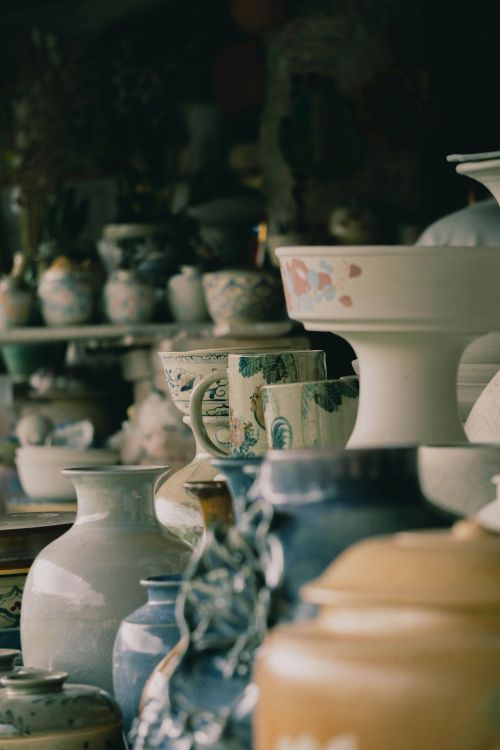
The white slip is never perfectly even. The brush marks are visible — sometimes bold, sometimes hesitant. The stamp patterns repeat, but never exactly. The glaze pools differently in each curve.
It is a record of a hand moving through clay. Of a specific morning in a specific workshop, centuries ago. No two are the same. That is not a flaw. That is the whole conversation.
A last thought.
We live in a time of surfaces that are optimized, filtered, corrected. Buncheong asks a different question —
What if the mark left by the making is the most honest part of the thing?
That question, it turns out, never goes out of style.