Every Buddhist temple in Korea is built in the mountains. Except this one.
There is a general principle in Korean Buddhist architecture: temples belong in the mountains. This is not arbitrary. The mountains provided physical separation from the political turbulence of court life, practical protection during periods of persecution, and a natural environment that Buddhist thought has long associated with clarity and spiritual withdrawal. Nearly every significant temple in Korea — Tongdosa, Haeinsa, Seonamsa, Beomeosa — sits in a forested valley or along a mountain slope, with the city at some remove below.
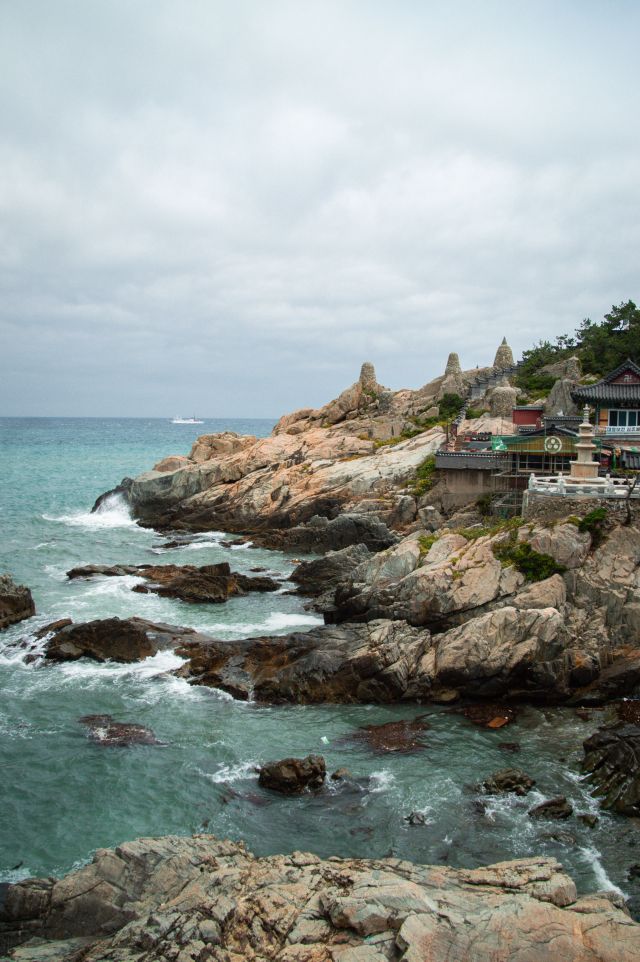
Haedong Yonggungsa breaks this principle completely. It sits not in the mountains but directly on the northeastern coast of Busan, in what is now Gijang-gun, on a promontory of exposed rock where the sea arrives from three directions and the sound of waves is continuous inside the temple grounds. There is no forested approach, no gradual withdrawal from the world. You descend 108 stone steps and arrive, almost without transition, at a complex of shrines and statues arranged across the rocks, with the East Sea spread out behind them.
It is, by any measure, an unusual place to put a temple. The story of why it is there is both historical and legendary — and the two accounts are worth keeping separate.
The Foundation and Its Destruction
The historical record is clear about the date: Haedong Yonggungsa was founded in 1376, during the Goryeo Dynasty, by the monk Naong Hyegeun — a figure of considerable importance in Korean Buddhist history who served as an advisor to King Gongmin and helped lay the groundwork for Buddhist practice in the subsequent Joseon era. The temple was originally named Bomunsa.
The legendary account of why Naong chose this location says that the Divine Sea God of the East Sea appeared to him in a dream and instructed him to build a temple on the coastal cliffs. If he did so, the dream promised, the nation would become larger and more stable. Whether or not one takes the dream literally, the effect is the same: a temple was built on the sea, in a location that defied the convention of mountain placement.
What happened next is documented more clearly. In 1592, during the Japanese invasion known as the Imjin War, the original temple structures were burned to the ground. The temple remained in ruins for more than three hundred years — an unusually long period of abandonment, even in a country whose sacred sites have repeatedly been damaged by conflict and subsequently rebuilt.
Reconstruction began in the early 1930s, when the monk Ungang of Tongdosa Temple restored the complex. The name was also changed during this period: from Bomunsa to Haedong Yonggungsa — 海東龍宮寺, which translates roughly as the Dragon Palace Temple of the Eastern Sea. The name reflects the temple’s dedication to the Goddess of Mercy, who in Korean Buddhist tradition is believed to reside in the sea. The temple’s current name was formally designated in 1974.
What the Complex Looks Like
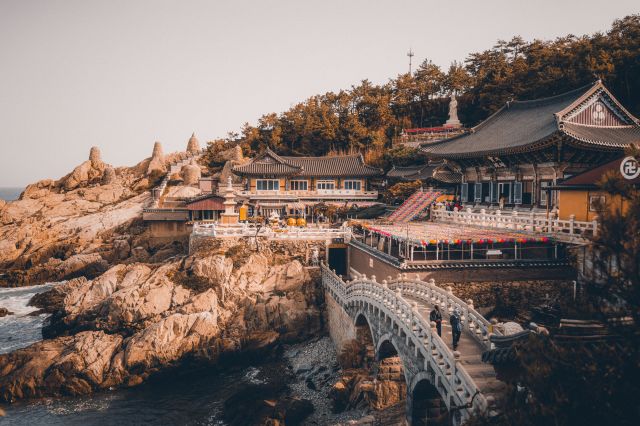
The approach to Haedong Yonggungsa begins before the temple itself is visible. From the parking area and the street-food vendors that now cluster at the entrance — a commercial layer that has developed around the temple’s tourism in recent decades — a path leads down toward the coast. The 108 steps are carved into the hillside, each step corresponding to one of the 108 earthly desires that Buddhist practice seeks to overcome.
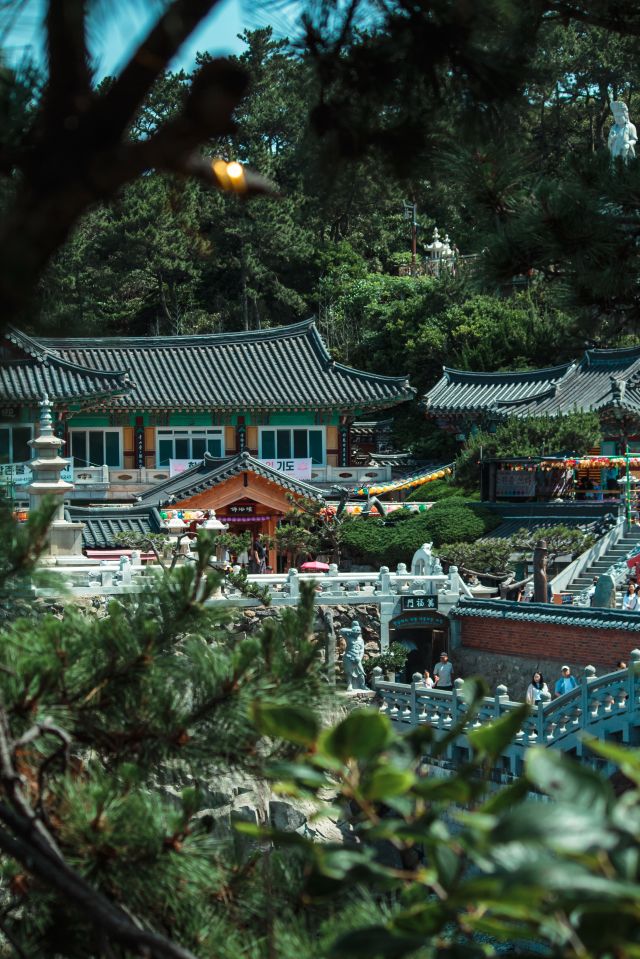
At the bottom, the complex opens across a series of rock platforms at sea level. The main hall, Daeungjeon, faces the water directly, with the sea as its permanent backdrop rather than as an incidental view. A three-tiered stone pagoda guarded by four lion statues stands on the rocks nearby. Several smaller shrines are tucked into the cliff face or positioned at the water’s edge. The Haesu Gwaneum Daebul — a large statue of the Goddess of Mercy — faces the open sea, her gaze directed outward, away from the land.
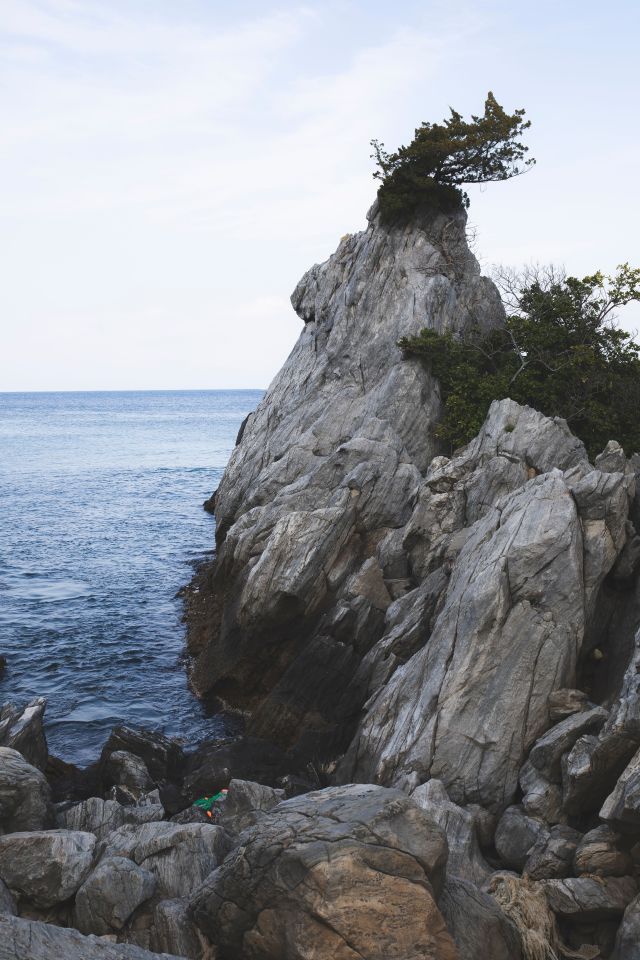
The tide determines a great deal about what the rocks look like on any given visit. At high tide, the sea comes close enough to the lower shrine areas that the sound and spray are immediate. At low tide, the exposed rock formations extend the available space and change the character of the site. The temple does not behave like a fixed architectural space; it responds to conditions.
There is also a cave shrine accessible at certain tide levels, dedicated to the Dragon King — a figure from Korean shamanistic tradition that the temple has incorporated alongside its Buddhist iconography, reflecting the long-standing integration of Buddhist and indigenous Korean religious practice that characterizes many Korean sacred sites.
The Practical Reality
Haedong Yonggungsa is genuinely crowded on weekends and holidays, and the crowds are worth planning around if you care about experiencing the place as anything other than a logistical challenge. The 108 steps become a slow-moving queue in peak conditions. The rock platforms fill with visitors taking photographs. The vendors at the entrance and the temple’s well-developed commercial infrastructure can make the approach feel less sacred than the guidebooks suggest.
Early morning is the correct answer. The temple is open from 4 AM, and the walk down the 108 steps in the hour after dawn — with the sea mist still on the water and the shrine area largely empty — produces a different experience from anything available at midday on a summer Saturday. The distance from central Busan is a factor, but the bus connections from the Haeundae area are manageable.
The temple’s location in Gijang-gun, the northeastern district of Busan beyond Haeundae, puts it at some distance from the main cluster of the city’s attractions. This distance is one of the reasons it remains less overwhelmed than it might otherwise be. Getting there requires a specific intention rather than falling naturally into a standard itinerary.
What Makes It Worth Going
What Haedong Yonggungsa offers is not primarily architectural complexity or historical depth — its current buildings are relatively recent, and the history involves centuries of ruins. What it offers is a spatial experience that genuinely has no equivalent among Korean sacred sites.
The combination of religious architecture with the immediate physical presence of the sea is unusual enough to stop you in the way that things which violate your expectations can stop you. You expect mountains. You find the ocean. You expect quiet withdrawal from the world. You find waves arriving directly at the shrine wall. The dissonance produces an attention that a more conventional temple might not.
The monk who had a dream in 1376 about building a temple on the sea did not explain himself clearly. But the place that resulted from that decision is, whatever else you make of it, unlike anything else in Busan or in Korea.