산복도로 — The Road That Runs Above the City

t was built for people who had nowhere else to live. Now it has one of the best views in Busan.


Draw a horizontal line above Busan’s port area, somewhere between the flat land of the reclaimed waterfront and the steeper slopes of the mountains rising behind it. That imaginary line runs through what is actually a road — or rather, a series of connected roads — that trace the mid-slope of the hills above central Busan, winding through neighborhoods that were built by people who arrived with nothing and had nowhere else to go.
This is Sanbok Road: 산복도로, literally “mountain abdomen road,” named for where it sits on the geography of the hills. It does not appear in many international travel guides. It is not organized around a single attraction. It does not have a neat beginning and end. What it has is context — layers of it, accumulated across several decades of a city growing faster than any planned structure could contain.
How the Road Came to Be

The story of Sanbok Road begins with the Korean War. When Busan became the last major city not under North Korean control in 1950 and 1951, the population swelled with refugees from across the peninsula. People needed somewhere to live, and the available flat land near the port filled quickly. What remained was the hillside — steep, difficult, without infrastructure, but available.
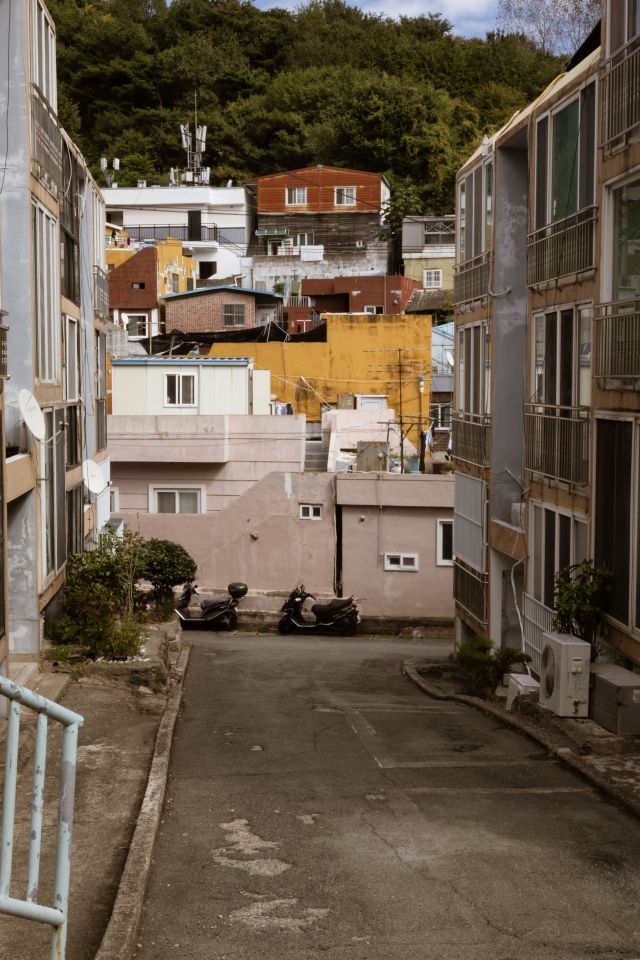
Refugees built on the slopes in the way that people build when the alternative is not building at all: with whatever materials could be found, in whatever configuration the terrain allowed. Corrugated metal, salvaged wood, stones for foundations. Houses arranged not according to any plan but according to the logic of the gradient — each built where the last had not yet been, climbing upward because upward was the direction in which space remained.
The road was built to serve these communities — to make the hillside neighborhoods accessible for basic services, supplies, and the movement of people between the slopes and the city below. It was functional infrastructure before it was anything else: a road for people who had no other road. As the postwar decades passed and the temporary settlements became permanent neighborhoods, the road became part of the permanent fabric of the city’s mid-slope communities.
The houses were rebuilt over time from metal and wood into brick, and from brick into concrete. The alleys were formalized. The communities acquired schools, small markets, community spaces. What had been emergency construction became settled life, and settled life accumulated the kind of texture — the particular arrangement of a neighborhood’s spaces, the specific quality of its light at particular hours, the relationship between buildings that develops only through unplanned growth — that planned developments do not produce.
What You Find on the Road

When you ride the bus routes that follow the Sanbok Road — or walk sections of it on foot, which is a slower and more immediate experience — the city resolves into something that its coastal and commercial areas do not show.
The view is the first thing. From the road, the harbor is visible below in a way that makes the relationship between the city and the water clear rather than incidental. The port infrastructure — the container terminals, the bridges, the industrial waterfront — is laid out in a comprehensible way. The older residential areas descend in stages toward the flat land. The mountains continue above. You are in the middle of the geography rather than at its edge.
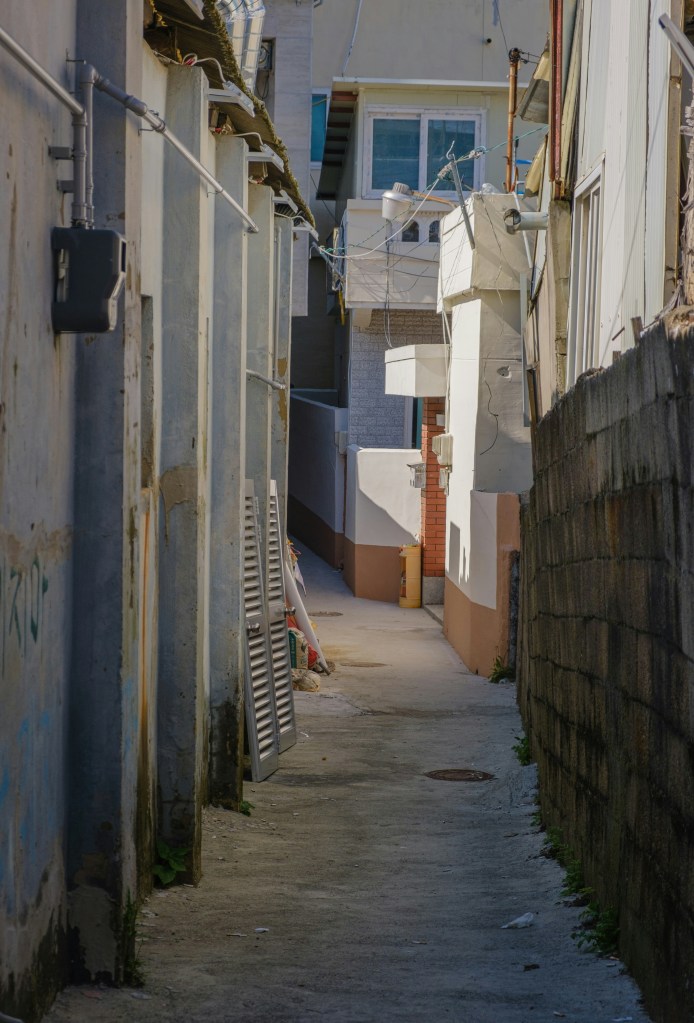
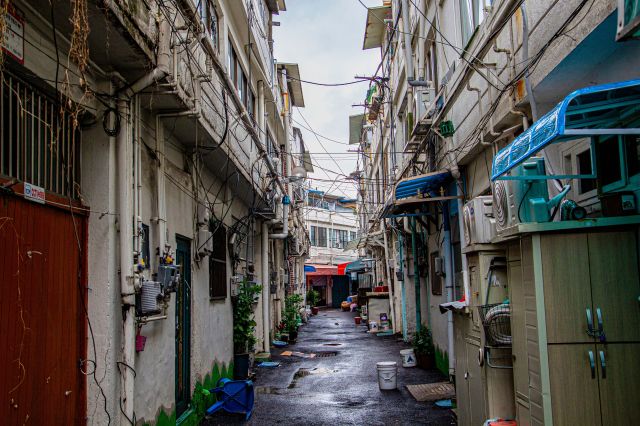
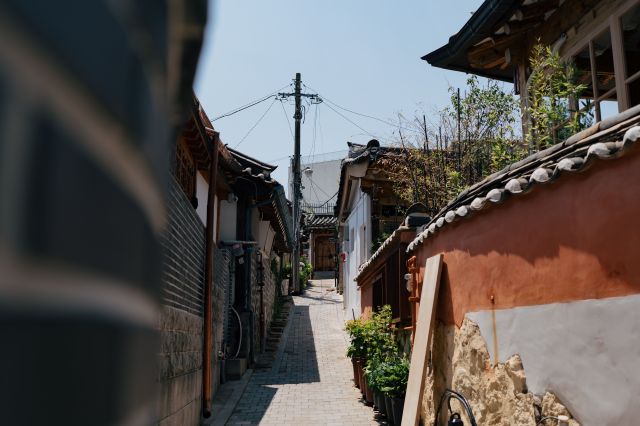
The neighborhoods that line the road have the character of communities that developed without consistent planning oversight: narrow alleys that branch off the main road and descend between tightly packed houses, small convenience stores and neighborhood restaurants that serve the people who live here rather than visitors passing through, walls with murals painted by community art projects that came and went. Some of the murals are good. Some are faded. The distinction matters less than the fact that the walls have been painted at all, which means people cared enough about the appearance of these alleys to do something about them.
The population along the road has aged as younger residents have moved to newer apartments in other parts of the city. The elderly residents who remain are the long-term inhabitants of communities that grew from wartime necessity into something with its own identity — people who have watched the city change below them for decades without the view from their windows ever disappearing.
The Circular Bus Route

One of the more useful pieces of local knowledge about Sanbok Road is the existence of bus routes specifically designed to follow it — circular routes that loop around the hillside neighborhoods and provide what amounts to a moving viewpoint tour of the mid-slope communities and their views over the city.
These routes exist primarily for the residents of the hillside neighborhoods, not for tourists. The buses run on schedules determined by the needs of people going to and from work, school, and the market. They do not narrate what you are seeing or stop at designated viewpoints. You simply sit on a bus as it follows a road that was built for people who had nowhere else to go, and the city is below you, and the view is as good as you will find anywhere in Busan.

A Different Kind of Busan

There is a version of Busan that is organized around the sea — the beaches, the harbor, the marine cable car, the view of the bridge at night. That version is real and significant and worth experiencing.
Sanbok Road represents a different axis: not the relationship between the city and the water, but the relationship between the city and the hills behind it. The road runs above the place where the city started, through communities that existed before Haeundae was developed, before the high-rise hotels arrived, before the city began marketing its coastal character to the world.
The people who built these neighborhoods on a steep hillside during and after a war did not think they were creating something interesting for later visitors to discover. They were solving an immediate problem. What they left behind is a different kind of interesting from what you plan and design: the specific texture of a community that grew because it had to, in the specific form that the terrain and the circumstances allowed.
The view over the port from mid-slope on a clear morning is one of the better views available in a city full of good views. Getting there requires going somewhere that does not appear on the standard route. That, in this context, is part of the point.
사투리 — Why Busan’s Accent Always Gets Cast as the Tough Guy

In Korean dramas, the Busan dialect has a role it did not audition for.

If you have watched a Korean drama with subtitles, you may not have noticed the dialect. The subtitles translate the meaning, not the sound, and the particular way someone from Busan speaks tends to disappear into the English equivalent of “he’s angry” or “she’s threatening him.”
But Korean viewers notice immediately. The Busan dialect — 사투리, saturi, a word that means regional accent or dialect — is one of the most recognizable in the country, and its associations in popular culture have become a kind of running character type. You know it when you hear it, and you know what character is about to do.

What the Dialect Actually Sounds Like

Standard Korean — the form taught in schools, spoken on news broadcasts, and associated with Seoul — has a relatively flat intonation. Sentences tend to end in a predictable pitch pattern. The rhythm is measured.
The Gyeongsang dialect, which includes the Busan accent, works differently. It is characterized by a rising and falling pitch that can make statements sound, to an unaccustomed ear, like questions or assertions of particular emphasis. The rhythm is faster and more clipped. Certain sentence endings that are common in Seoul Korean — the softening particles, the polite hedging — are compressed or dropped entirely. The dialect sounds, from the outside, direct. Sometimes blunt. Sometimes, depending on who you ask, aggressive.
In Busan specifically, there are features that people who grow up here absorb without thinking about: words that contract in particular ways, expressions that do not exist in the standard form, and the general quality of the speech that carries the city’s particular character. Locals often say that Busan speech sounds warmer and more open than outsiders perceive it — that the directness comes from comfort and confidence rather than hostility, and that it reads as harsh only to people who are not used to it.
This distinction — between how the dialect sounds to someone from Busan and how it sounds to someone from Seoul — sits at the center of a cultural phenomenon that has shaped the Busan accent’s reputation on screen.

The Casting Problem

In Korean dramas and films, the Gyeongsang dialect — and the Busan dialect specifically — has been used as a consistent shorthand for a particular character type. The powerful villain who speaks in a low, rough accent from the south. The crime boss whose authority is communicated partly by how he sounds. The enforcer whose threats feel more physical when delivered in the Busan dialect’s particular cadence.
This is not an invented association. It developed over decades of Korean media, during which Gyeongsang dialect became linked with strength, toughness, and often moral ambiguity in ways that standard Korean was not. Some of Korea’s most memorable screen villains speak with an accent from this region. The association became self-reinforcing: the dialect is used for a certain kind of character, and so audiences come to expect that kind of character when they hear the dialect.
The pattern is not unique to Korea. Regional dialects in almost every country carry associations that their speakers did not choose and often find reductive. People from the American South, from certain parts of England, from particular regions of France — all deal with versions of the same phenomenon, where the sound of where you come from carries an attached narrative that lives in other people’s minds.
For people from Busan, the character type can be amusing, sometimes flattering in a particular way, and sometimes genuinely tiring. The city is not primarily organized around the things its dialect represents on screen. It is a city of four million people with the full range of personalities, occupations, and ways of being in the world. The fact that a particular sound marks you as coming from here tells viewers very little about who you actually are.

When Dialect Functions as Identity

There is another side to the Busan accent’s profile that the villain-casting narrative tends to obscure.
Within Busan — and in conversations between people who share the accent — the dialect is a form of recognition and belonging. You hear someone speak and you immediately know they are from here, or have lived here long enough that the city has changed how they talk. This matters in a country where regional identity is real and where the difference between how someone sounds in Busan and how someone sounds in Seoul is immediately noticeable.
The accent also softens significantly depending on context. Busan speakers who move to Seoul for work often find themselves automatically code-switching — moderating the accent, adopting more standard patterns, returning to the fuller dialect when they come back. This is a common experience across many regional speech communities, and it reflects the quiet social pressure toward the standard form that exists in most centralized countries. The capital’s speech becomes neutral; everything else is marked.
People who grew up in Busan and live here now speak the dialect most fully in casual conversation — with family, with old friends, in the market, in the places where no one is watching or evaluating how you sound. This is when the language is most itself. The self that it reveals is not the crime boss from a drama. It is something considerably more ordinary, and more genuinely Busan, than that.

The Phrase That Carries a City

오이소, 보이소, 사이소 — the phrase from Jagalchi Market that means come, see, buy — is written in standard Korean romanization as a kind of curiosity, but in the Busan dialect, the sounds and the rhythm are specific. It is not how you would say those words in Seoul. The compression, the speed, the particular shape of each word — these are features of the dialect and features of the city at the same time.
Linguists study saturi as one of several surviving regional Korean dialects, each with its own grammatical patterns and phonological characteristics that developed over centuries of relative geographic separation. The Gyeongsang dialect family, of which Busan speech is a member, is considered distinct enough from standard Korean to be genuinely challenging for learners working from Seoul-based textbooks.
People from Busan tend to know this and take a quiet pride in it. The dialect is theirs. The casting decisions are television’s. The two things have always been separate, whatever the credits might suggest.

해운대 — What Busan’s Most Famous Beach Looks Like When You Live Here

Ten million visitors every summer. And the people who actually live here go somewhere else.

Haeundae Beach is 1.46 kilometers long and about 40 meters wide at most. That is not a large piece of land. Yet in summer — specifically in the weeks between late July and mid-August — that stretch of sand accommodates up to 120,000 people on a single day. The umbrellas go up before sunrise. By midmorning there is no visible sand between them.
Photographs of this scene have circulated so widely that Haeundae has become Korea’s most recognizable image of summer. The wall of high-rise hotels behind the beach. The dense crowd at the water’s edge. The way the whole thing looks, from above, like a city that decided to move temporarily to the shore.
If you live in Busan, you have seen this image so many times that it no longer looks like a place you would visit. You know it looks like that. That is the problem.

The Name and Where It Came From

The name Haeundae — 해운대 — does not refer to the beach itself. It was the pen name of Choi Chi-won, a scholar and poet of the late Silla Kingdom who lived from 857 CE into the early tenth century. He is said to have traveled through this stretch of coastline, found it beautiful enough to carve his pen name into a rock on what is now Dongbaek Island, and left. The landscape kept the name.
For most of Korean history after that, the area remained a small fishing settlement. It was not particularly accessible or well known. Japanese visitors began using it as a seaside resort after Busan’s port opened in 1876, drawn by both the beach and the hot springs that still flow nearby. The beach became more widely accessible to Korean visitors when a railway line opened through the area in 1934. The US military used the beachfront during the postwar occupation period, and it was not officially opened to the Korean public until 1965.
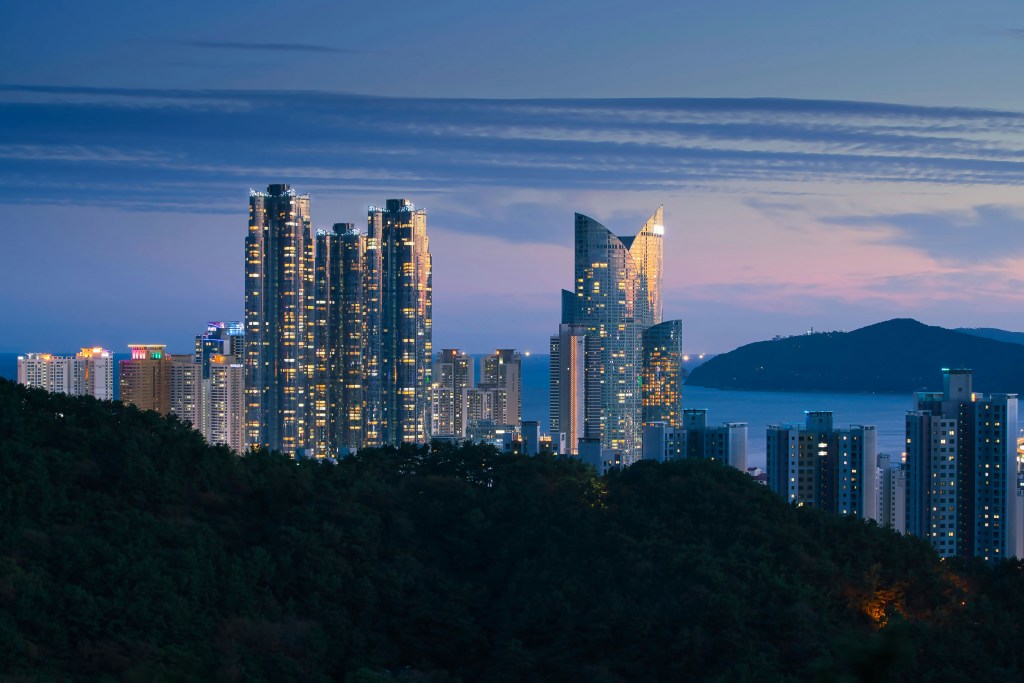
In less than a generation after that opening, Haeundae transformed completely. By the 1990s, the pine forests behind the sand had been replaced by hotels. Marine City, the cluster of luxury residential towers that now frames the western end of the beach, rose from what had been open land. The skyline that visitors photograph today was built almost entirely within living memory.

What Visitors Come For

The beach is genuinely beautiful outside of peak season. In spring and autumn, the sand is wide and pale, the water is visible from one end of the bay to the other, and the crowd is manageable. The cafes along Dalmaji-gil, the curved hillside road overlooking the beach from the east, fill with people who have walked up from the shore to sit with a coffee and look at the sea. In winter, the beach empties almost completely, and the Polar Bear Festival — held every January since 1988 — draws a few thousand people who swim in the near-freezing water anyway, for reasons that vary from personal challenge to a kind of public theater.
Near the western end of the beach, Dongbaek Island sits connected to the mainland by a walkway that was once open water. The island is forested with camellia trees and has a coastal trail that circles its edge, passing through shade and emerging at points that open directly onto the sea. At the island’s edge, the Nurimaru APEC House — built in traditional Korean architectural style for the 2005 APEC Summit — is open to visitors and offers one of the cleaner views of both Marine City and the wider curve of the bay.
The hot springs are real, and accessible at a public footbath near the beach’s tourist information center, free of charge. The Haeundae Traditional Market, a few streets back from the shore, sells gukbap — a rice and soup dish that has been a Busan breakfast staple for decades — at prices that have not kept up with the neighborhood around them.

What the Beach Looks Like to Locals

The thing about Haeundae is that its reputation has become its defining characteristic. Everyone knows it is famous. Everyone knows it will be crowded. And this knowledge, repeated often enough, becomes the thing itself.
Ask someone who grew up in Busan where they go to swim in summer, and you will rarely hear Haeundae as the first answer. You will hear Songjeong Beach, a smaller, rockier cove a few kilometers northeast that local families have been visiting for generations, where the water is cleaner and there is still some possibility of finding a patch of sand to sit on. You will hear Ilgwang, further along the coast, which requires more effort to reach and is quieter for it. You might hear Dadaepo, at the opposite end of Busan, where the wide tidal flats extend at low tide and the sunsets arrive without the backdrop of skyscrapers.
Haeundae is not avoided — that would be overstating it. People from Busan walk its promenade at night when the crowd has thinned and the Marine City lights are reflected in the water. They eat at the restaurants nearby. They bring visiting relatives to see what all the photographs are about. They watch the beach’s annual fireworks display from a distance, because standing inside the crowd has never appealed.
But the beach that fills every international travel guide and every summer news broadcast about Korea — the beach with 10 million annual visitors, the beach you can recognize from a photograph from almost anywhere in the world — is not the beach that the city itself treats as its own. That particular tension, between a place’s global reputation and its local reality, is something Haeundae carries unusually visibly.

The View from Outside the Frame

There is a photograph that gets taken at Haeundae more than any other. It is taken from somewhere elevated — from a hotel window, or from one of the higher points on Dalmaji-gil — looking down at the beach in peak summer. The sand is invisible beneath the umbrellas. The towers rise behind it. The sea, beyond the crowd, is open and blue.
This photograph is accurate. It is exactly what Haeundae looks like in late July.
What it does not show is the same beach in October, when the umbrellas are gone and the sand is back and the sea turns a deeper, greener shade. It does not show the early mornings when people jog the promenade before anything is open. It does not show the winter light on the water, or the way the camellia trees on Dongbaek Island flower in a season when most people have forgotten the beach exists.
The famous image of Haeundae is real. The beach beyond that image is also real.

In a city this size, both get to exist at the same time.