Ten million visitors every summer. And the people who actually live here go somewhere else.
Haeundae Beach is 1.46 kilometers long and about 40 meters wide at most. That is not a large piece of land. Yet in summer — specifically in the weeks between late July and mid-August — that stretch of sand accommodates up to 120,000 people on a single day. The umbrellas go up before sunrise. By midmorning there is no visible sand between them.
Photographs of this scene have circulated so widely that Haeundae has become Korea’s most recognizable image of summer. The wall of high-rise hotels behind the beach. The dense crowd at the water’s edge. The way the whole thing looks, from above, like a city that decided to move temporarily to the shore.
If you live in Busan, you have seen this image so many times that it no longer looks like a place you would visit. You know it looks like that. That is the problem.
The Name and Where It Came From
The name Haeundae — 해운대 — does not refer to the beach itself. It was the pen name of Choi Chi-won, a scholar and poet of the late Silla Kingdom who lived from 857 CE into the early tenth century. He is said to have traveled through this stretch of coastline, found it beautiful enough to carve his pen name into a rock on what is now Dongbaek Island, and left. The landscape kept the name.
For most of Korean history after that, the area remained a small fishing settlement. It was not particularly accessible or well known. Japanese visitors began using it as a seaside resort after Busan’s port opened in 1876, drawn by both the beach and the hot springs that still flow nearby. The beach became more widely accessible to Korean visitors when a railway line opened through the area in 1934. The US military used the beachfront during the postwar occupation period, and it was not officially opened to the Korean public until 1965.
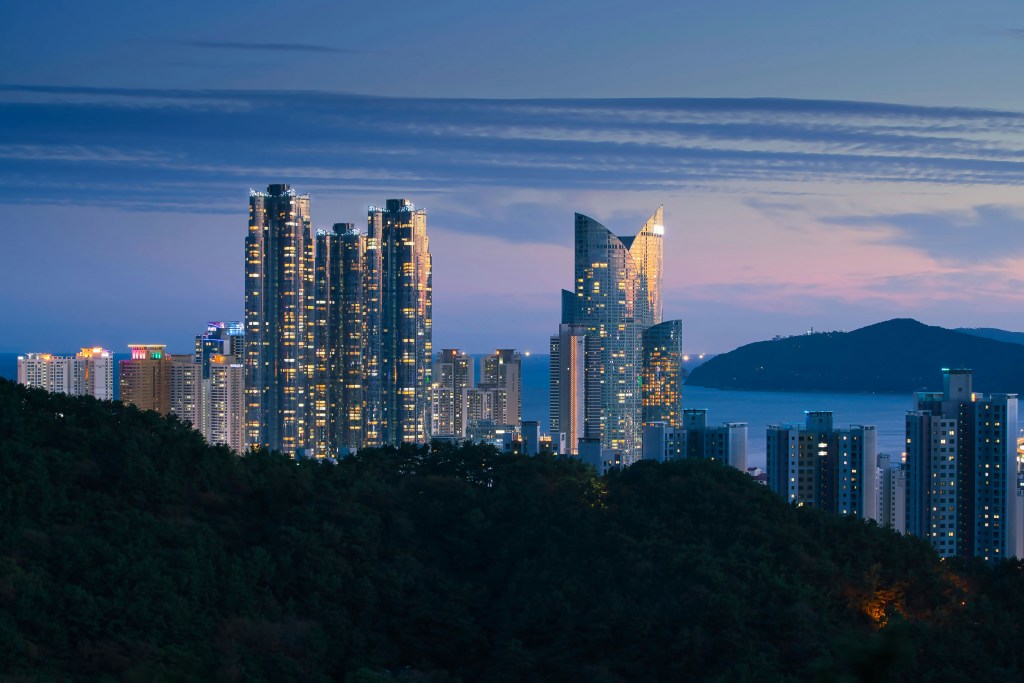
In less than a generation after that opening, Haeundae transformed completely. By the 1990s, the pine forests behind the sand had been replaced by hotels. Marine City, the cluster of luxury residential towers that now frames the western end of the beach, rose from what had been open land. The skyline that visitors photograph today was built almost entirely within living memory.
What Visitors Come For
The beach is genuinely beautiful outside of peak season. In spring and autumn, the sand is wide and pale, the water is visible from one end of the bay to the other, and the crowd is manageable. The cafes along Dalmaji-gil, the curved hillside road overlooking the beach from the east, fill with people who have walked up from the shore to sit with a coffee and look at the sea. In winter, the beach empties almost completely, and the Polar Bear Festival — held every January since 1988 — draws a few thousand people who swim in the near-freezing water anyway, for reasons that vary from personal challenge to a kind of public theater.
Near the western end of the beach, Dongbaek Island sits connected to the mainland by a walkway that was once open water. The island is forested with camellia trees and has a coastal trail that circles its edge, passing through shade and emerging at points that open directly onto the sea. At the island’s edge, the Nurimaru APEC House — built in traditional Korean architectural style for the 2005 APEC Summit — is open to visitors and offers one of the cleaner views of both Marine City and the wider curve of the bay.
The hot springs are real, and accessible at a public footbath near the beach’s tourist information center, free of charge. The Haeundae Traditional Market, a few streets back from the shore, sells gukbap — a rice and soup dish that has been a Busan breakfast staple for decades — at prices that have not kept up with the neighborhood around them.
What the Beach Looks Like to Locals
The thing about Haeundae is that its reputation has become its defining characteristic. Everyone knows it is famous. Everyone knows it will be crowded. And this knowledge, repeated often enough, becomes the thing itself.
Ask someone who grew up in Busan where they go to swim in summer, and you will rarely hear Haeundae as the first answer. You will hear Songjeong Beach, a smaller, rockier cove a few kilometers northeast that local families have been visiting for generations, where the water is cleaner and there is still some possibility of finding a patch of sand to sit on. You will hear Ilgwang, further along the coast, which requires more effort to reach and is quieter for it. You might hear Dadaepo, at the opposite end of Busan, where the wide tidal flats extend at low tide and the sunsets arrive without the backdrop of skyscrapers.
Haeundae is not avoided — that would be overstating it. People from Busan walk its promenade at night when the crowd has thinned and the Marine City lights are reflected in the water. They eat at the restaurants nearby. They bring visiting relatives to see what all the photographs are about. They watch the beach’s annual fireworks display from a distance, because standing inside the crowd has never appealed.
But the beach that fills every international travel guide and every summer news broadcast about Korea — the beach with 10 million annual visitors, the beach you can recognize from a photograph from almost anywhere in the world — is not the beach that the city itself treats as its own. That particular tension, between a place’s global reputation and its local reality, is something Haeundae carries unusually visibly.
The View from Outside the Frame
There is a photograph that gets taken at Haeundae more than any other. It is taken from somewhere elevated — from a hotel window, or from one of the higher points on Dalmaji-gil — looking down at the beach in peak summer. The sand is invisible beneath the umbrellas. The towers rise behind it. The sea, beyond the crowd, is open and blue.
This photograph is accurate. It is exactly what Haeundae looks like in late July.
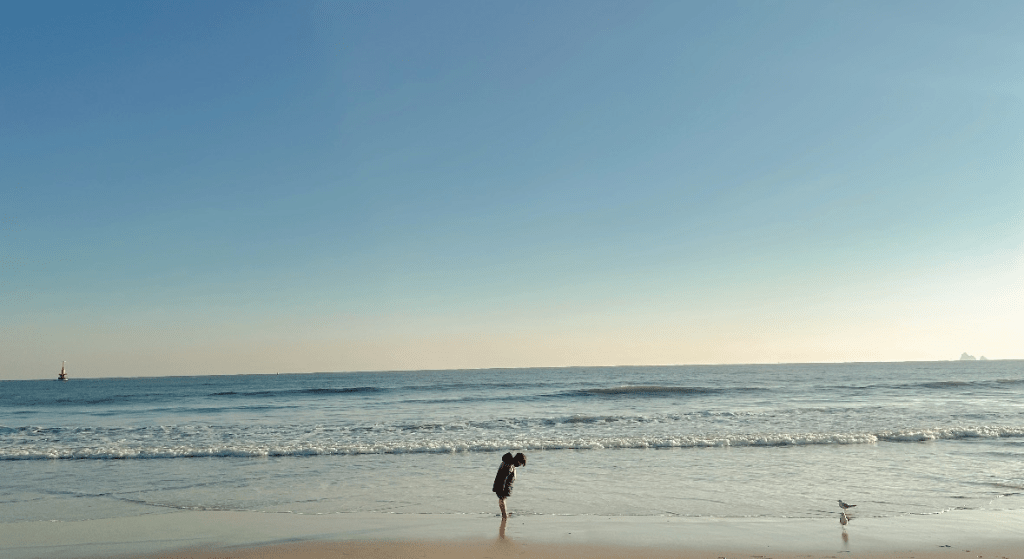
What it does not show is the same beach in October, when the umbrellas are gone and the sand is back and the sea turns a deeper, greener shade. It does not show the early mornings when people jog the promenade before anything is open. It does not show the winter light on the water, or the way the camellia trees on Dongbaek Island flower in a season when most people have forgotten the beach exists.
The famous image of Haeundae is real. The beach beyond that image is also real.
In a city this size, both get to exist at the same time.

